
Early in my career, I'd walk out of meetings frustrated. "They just don't get it," I'd mutter to myself, convinced I was surrounded by people who couldn't see the obvious.
Plot twist: The problem was me.
Understanding isn't about being right—it's about being understood. And I was doing a whole lot of explaining without any actual translating.
The Core Idea
Most communication fails not because people don't have good ideas, but because they explain things in their own language instead of translating them into the listener's.
Here's the thing about explaining: it dumps data. You open your mouth and pour out everything you know about the topic, expecting the other person to sort through it and find the relevant bits. It's like handing someone a puzzle box and walking away.
Translation is the opposite. It reduces cognitive load. Instead of making the listener do the heavy lifting, you've already done the work of connecting your knowledge to their context.

Think of it this way: Explaining is showing someone a map. Translating is giving them directions from where they're standing.
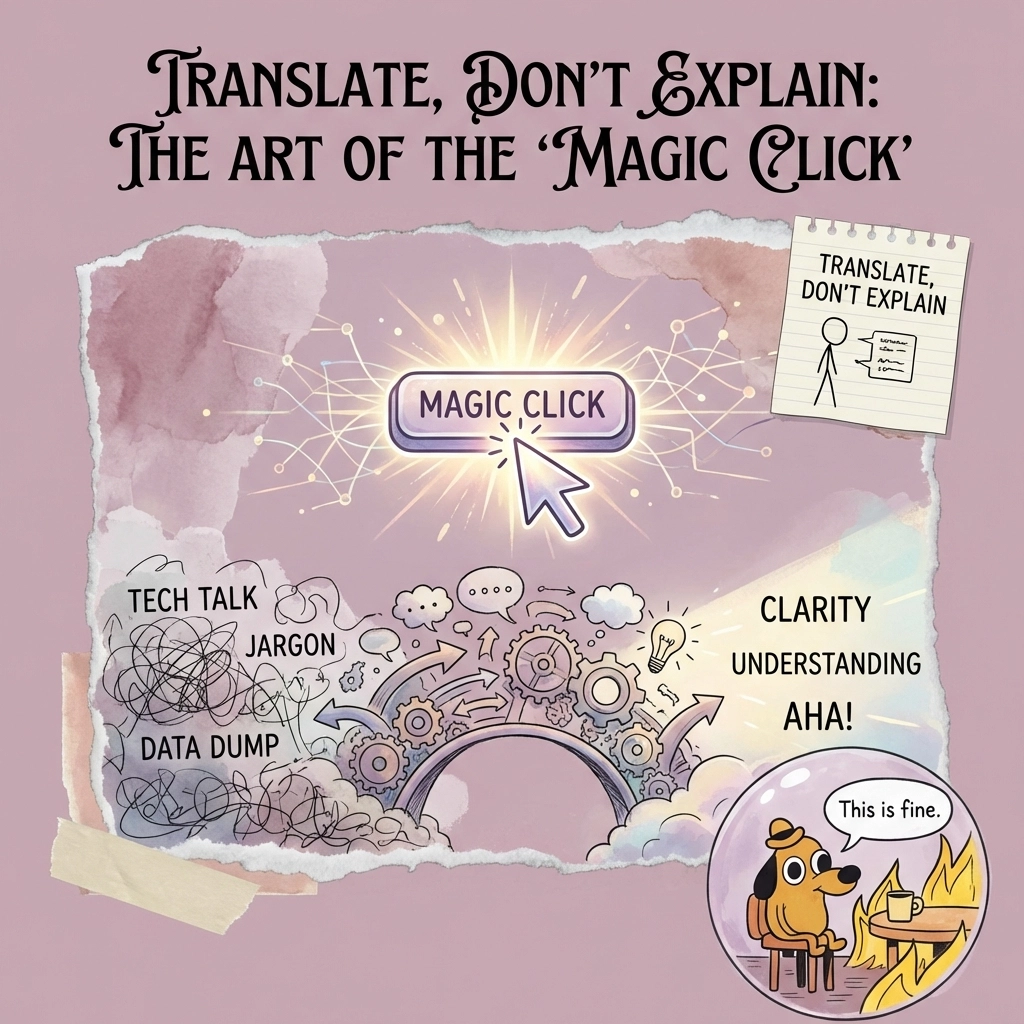
The goal isn't to say what you know. It's to say what they need to hear. And the ultimate measure of success? What I call The Magic Click—that moment when someone's face shifts from polite nodding to genuine understanding. When the "why" behind the "what" suddenly lands.
You can't fake The Magic Click. And you definitely can't explain your way to it.
At Work: The Language Gap
This is where I spend most of my consulting time—standing in the gap between engineers and executives who are talking past each other completely.
It's not that either side is wrong. They're just optimizing for different things.
Engineers optimize for:
- • System health
- • Technical correctness
- • Long-term maintainability
Executives optimize for:
- • Speed to market
- • Revenue impact
- • Competitive positioning
Both are valid. Both are necessary. But when an engineer says "we need to refactor the auth service" and an exec hears "we want to delay the roadmap for something invisible," you've got a language gap that no amount of Jira tickets will fix.
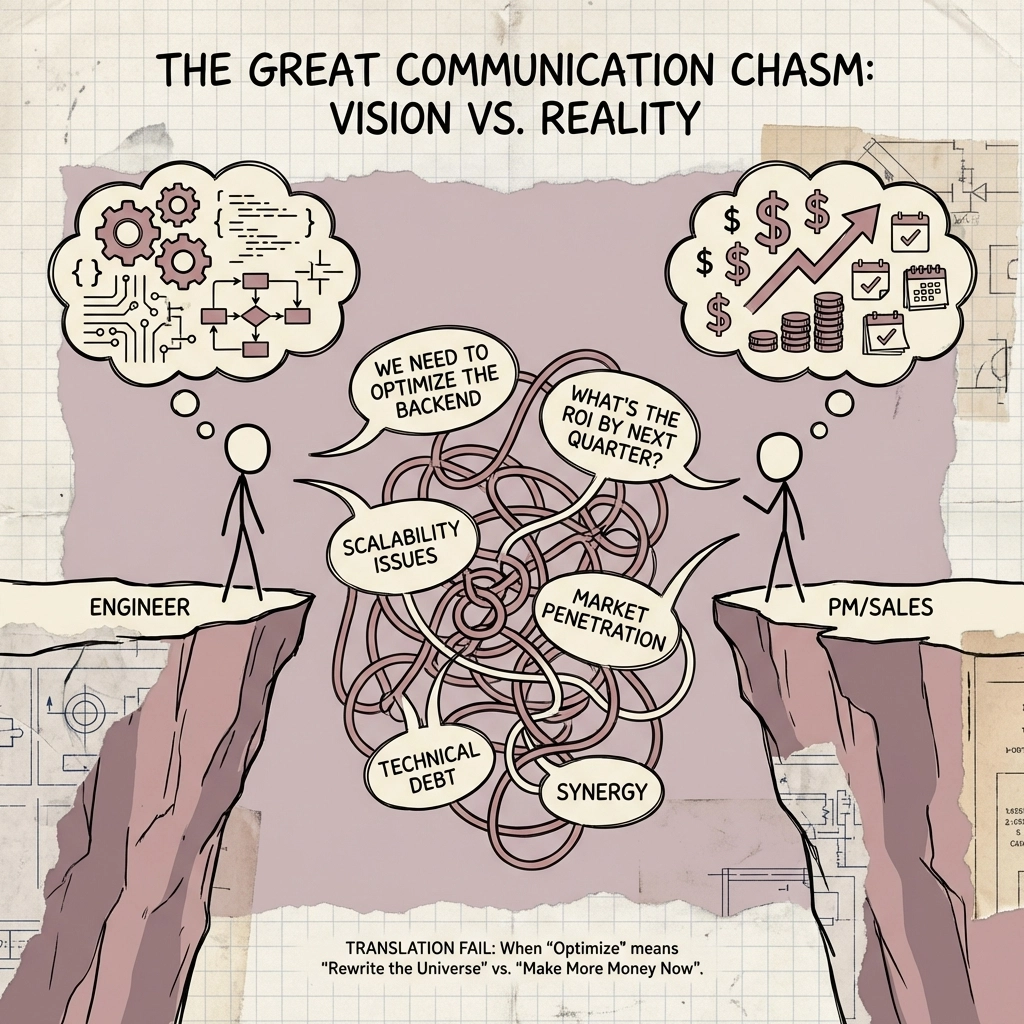
Translation means framing your point in terms of what the other person values—not abandoning your perspective, just presenting it in their language. It's not about being nice. It's about technical strategy delivery that actually lands.
The Translation Shift
Here's what this looks like in practice:
| Explaining (Dumps Data) | Translating (Reduces Friction) |
|---|---|
| "We need to refactor the auth service because the current implementation has O(n²) complexity." | "Login times will 10x when we hit 100k users. We can fix it now in 2 weeks or scramble later when customers complain." |
| "Can you just add this feature by Friday?" | "If we need this by Friday, what would we have to cut or what risks would we take?" |
| "The CI/CD pipeline is flaky." | "We're losing 3 hours per deploy to failed builds. That's 15 engineer-hours a week we could redirect to the Q2 launch." |
| "Users don't understand the onboarding flow." | "We're losing 40% of signups before they see the product. A simpler first screen could recover half of them." |
See the pattern? The explaining column is accurate. The translating column is useful.
One gets you a polite nod. The other gets you The Magic Click.
Building Ladders, Not Dumbing Down
Here's a misconception I need to kill: translation is not simplification.
When people hear "translate for your audience," they often think it means watering down the message, removing nuance, or treating the listener like they're not smart enough to handle the real version.
That's not translation. That's condescension with a smile.
Real translation is about building ladders. You're not lowering the ceiling—you're giving people a way to climb to where you are. You're connecting new information to something they already understand, using their vocabulary to illuminate your expertise.
The 80/20 rule applies here too: 20% of your knowledge is probably driving 80% of the impact in any given conversation. Translation means ruthlessly prioritizing that 20% and trusting you can fill in the rest later.
Intent Decay: The Translation Tax
Here's a dirty secret of organizational life: Engineering Intent Decay is real, and it's expensive.
A strategy starts crystal clear in someone's head. Then it gets communicated to a team lead, who interprets it and passes it to their team, who interprets it and builds something that... kind of resembles the original intent if you squint.
Every layer of the organization acts like a game of telephone. By the time a CEO's vision reaches the people actually building the product, it's been translated—poorly—five or six times.
This is the translation tax that leaders pay when they don't invest in making their intent portable.
The solution isn't more documentation. It's better translation at every handoff. It's asking "what did you hear me say?" instead of "does that make sense?" It's checking for The Magic Click instead of assuming it happened.
In Relationships: Listening for Meaning
Translation isn't just a work skill. It's a life skill.
When someone says they're "fine," are they fine? Or are they saying "I don't want to get into it right now"? When your partner says "it's not a big deal," is it not a big deal?
The best relationships—romantic, professional, familial—are built by people who translate in both directions. They express themselves in ways their partner can receive, and they interpret their partner's words through the lens of what they actually mean.
The practice: Instead of responding to what someone said, respond to what they meant. "It sounds like you're feeling..." is almost always more useful than "But you said..."
In Conflict: Finding the Shared Frame
Most conflicts aren't really about the thing you're arguing about. They're about different underlying values or needs that aren't being acknowledged.
Translation in conflict means stepping back and asking: "What does this person actually need here? What are they protecting?"
You don't have to agree with someone's position to understand their perspective. And understanding their perspective is the first step to finding common ground.
Often, once you name the real concern, the surface disagreement dissolves. That's The Magic Click in conflict resolution.
How to Practice This
1. Pause before speaking
Ask yourself: What does this person care about? What's their context? What problem are they trying to solve?
2. Lead with their 'why'
Start with the outcome that matters to them, not the process that matters to you.
3. Use their vocabulary
If they say "revenue," don't say "ARR." If they say "users," don't say "DAU." Match their language, not your preferred jargon.
4. Check for understanding
Not "does that make sense?" (everyone says yes to that). Try "what questions do you have?" or "how does that land for you?"
5. Watch for The Magic Click
You'll know it when you see it. The posture shifts. The nodding becomes real. They start building on your idea instead of just receiving it.
The Takeaway
Understanding isn't about being right—it's about being understood. Meet people where they are, not where you think they should be.

The Magic Click—Leadership isn't about having the best ideas. It's about making your ideas portable enough that other people can carry them forward.
I don't translate because I'm nice. I translate because I want things to actually happen.
Need help bridging communication gaps on your team?
I help teams stop talking past each other and start achieving The Magic Click.
Let's talk →