
The Napkin Test: If It Doesn't Fit on a Napkin, It Isn't a Strategy
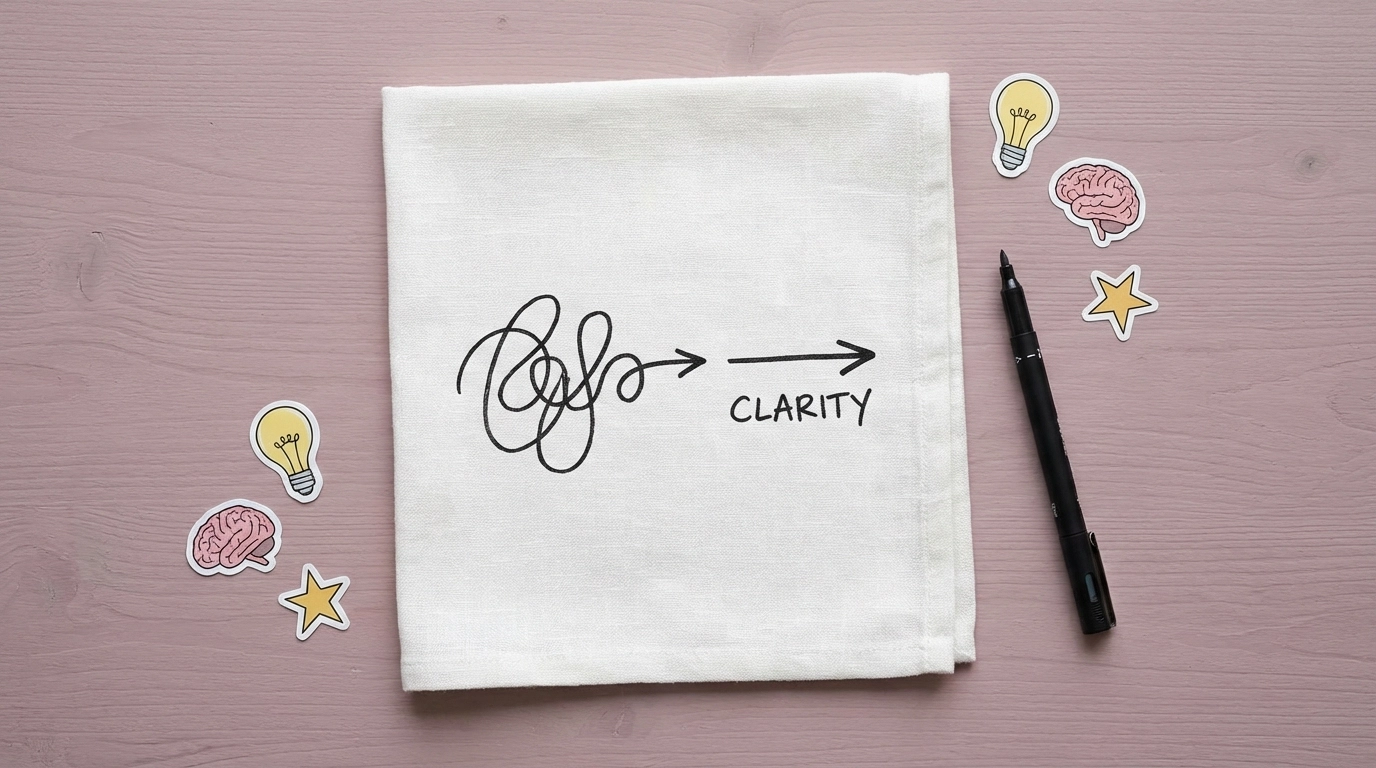
Complexity is easy. Clarity is the hard part.
I've watched brilliant people drown in their own intelligence. Engineers who can architect systems that would make NASA jealous, but can't explain why the project matters to the CEO. Executives who've memorized every acronym in the business lexicon but couldn't tell you what their team actually does in plain English.
Here's the uncomfortable truth: if you can't explain it simply, you don't understand it yet.
The Core Idea
I have a simple test for whether I actually understand something: Can I explain it on a napkin to someone smart who has no context? In under two minutes?
If yes, I get it. If no, I'm still figuring it out—and no amount of complexity will hide that.
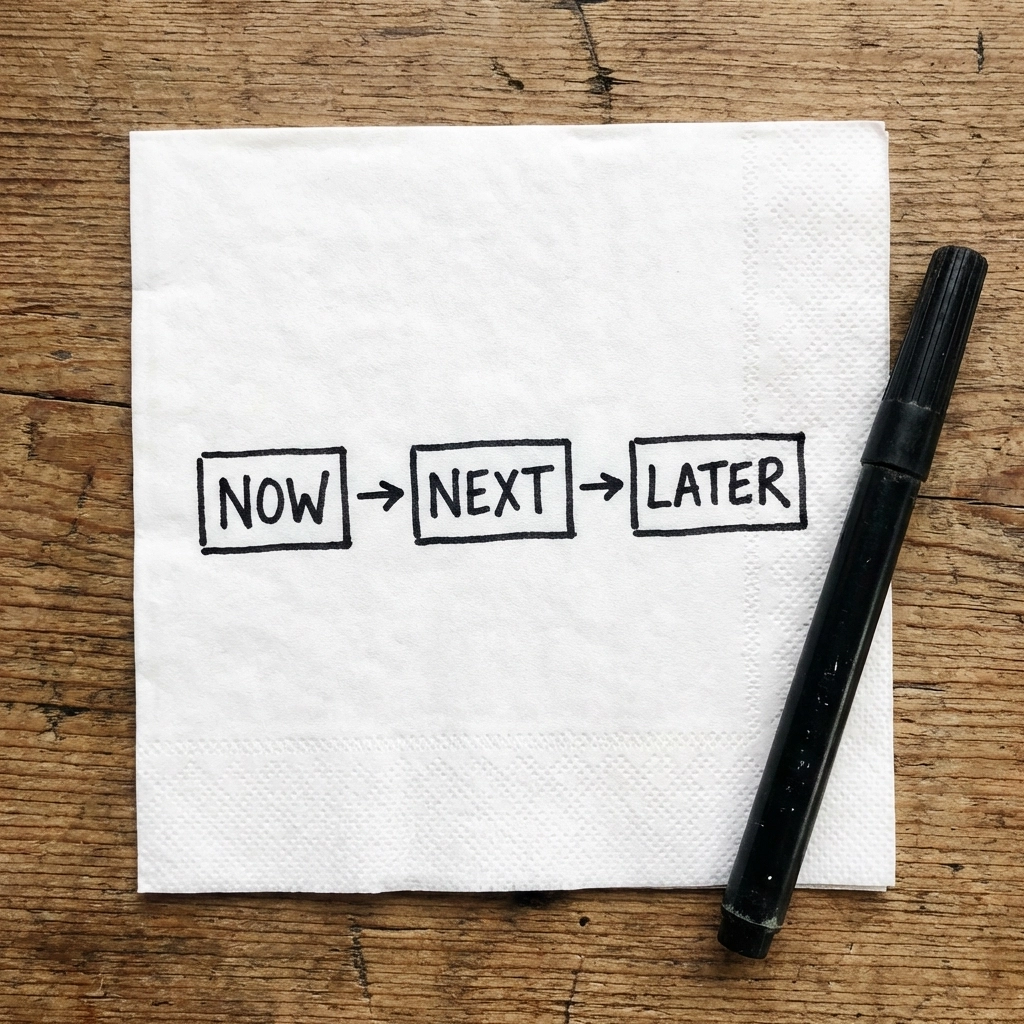
The napkin test isn't about dumbing things down. It's about distilling to essence. The best ideas are simple at their core—the complexity comes in execution.
This principle shows up everywhere. In real estate, attorney Marvin Starr pioneered a "Napkin Test" for 1031 exchanges that boils complex tax analysis down to three factors you can compare in minutes. In social impact work, "Napkin Math" moves ideas from abstract brainstorming to tangible numbers with back-of-the-envelope calculations.
The underlying logic is universal: strategic clarity requires simplicity. If you can't quickly draw and communicate your strategy from memory, it likely lacks clarity or has become unnecessarily complex.
In my work as a fractional technical leader, this is where I live. Translating intricate technical strategy delivery into something a board can act on. Finding the signal in the noise. Turning 47-page architecture documents into a single sentence that actually moves decisions forward.
Strategy: One Sentence or It's Not a Strategy
I've sat through hundreds of strategy presentations. Fifty-slide decks. Roadmaps that need their own roadmaps. Quarterly plans so detailed they become projects themselves.
Here's the truth: if nobody can summarize the strategy in one sentence, the strategy doesn't exist yet. You just have a collection of ideas wearing a strategy costume.
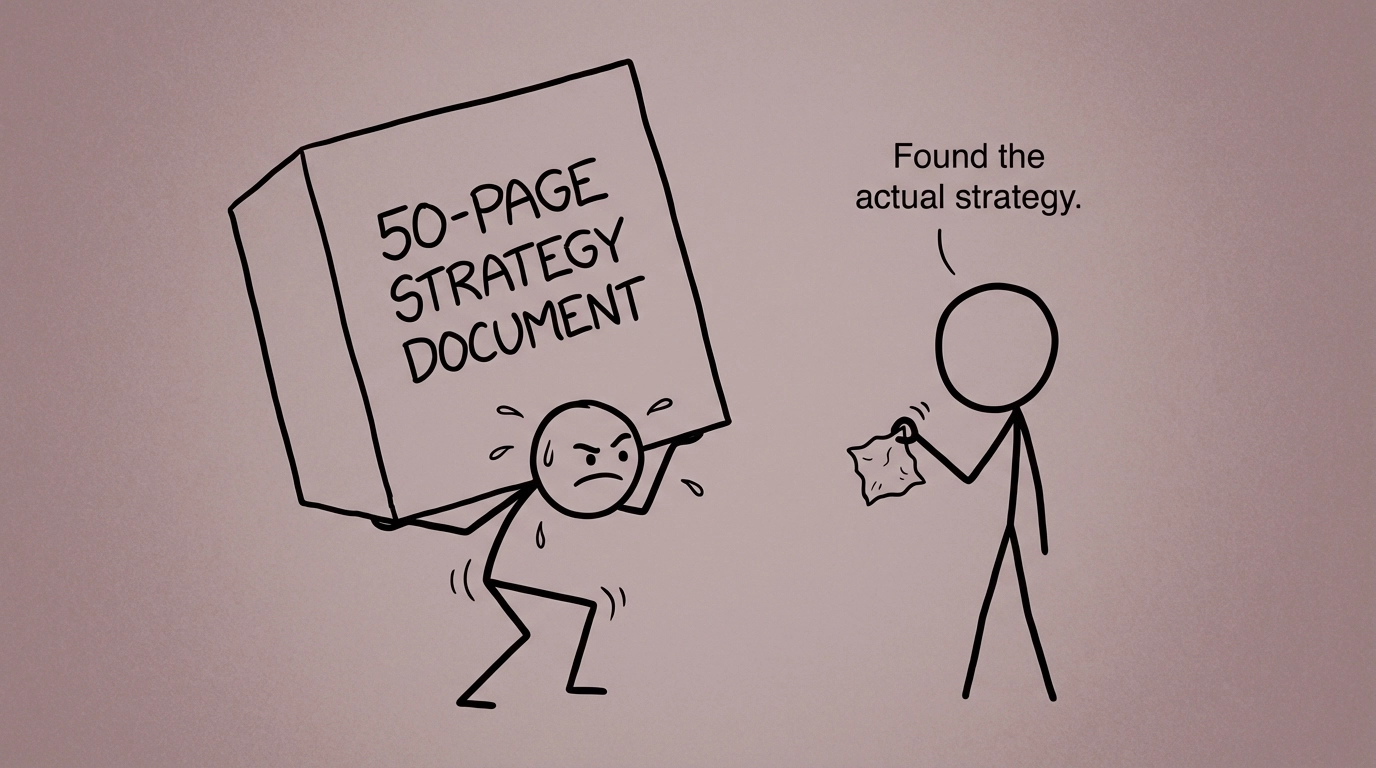
I worked with a Series B startup last year that had a "strategic plan" spanning 73 pages. When I asked the leadership team to each write down the company's strategy on an index card, I got six completely different answers. Six people. Same company. Same meetings. Zero alignment.
That's not a strategy problem. That's a clarity problem.
The format I use for the napkin test:
"We're doing [action] for [audience] because [reason], which will result in [outcome]."
That's it. If you can't fill in those blanks clearly, you're not ready to build the deck. You're still finding the strategy. This is where systems thinking becomes essential. A real strategy isn't a list of things you want to do—it's an understanding of which levers actually move the system.
Decisions: The Clearest Option Usually Wins
When I'm stuck between options, I ask: which one can I explain most simply? The answer is usually the right choice.
Complicated rationales often hide weak thinking. If you need a complex argument to justify something, it's worth asking if you're convincing yourself rather than discovering truth.
| ❌ Complexity | ✓ Clarity |
|---|---|
| "Let's gather more data before deciding." | "Here's what we know, here's what we'll do, here's when we'll reassess." |
| "We need to consider all stakeholder perspectives before moving forward." | "The customer wants X. We're building X. Ship date is Friday." |
| "It's complicated, let me walk you through the seventeen factors." | "Two things matter here. Everything else is noise." |
I once watched a team spend three weeks building a decision matrix with weighted criteria, stakeholder impact scores, and a custom voting system. The decision they were making? Which project management tool to use. The napkin version: "Does it integrate with Slack? Great. Ship it."
Communication: TL;DR First, Details on Request
Every email, every presentation, every conversation—I try to lead with the TL;DR. What's the one thing you need to take away?
This connects directly to the translation framework. Most communication fails because people explain things in their own language instead of translating into the listener's context. The napkin test forces you to find the universal version—the one that works regardless of the audience's expertise.
Details should be demand-driven, not supply-driven. Most people don't need to know how the sausage is made—they just need to trust that it's good.
The test: If you removed this detail, would the audience still understand what to do and why it matters? If yes, remove it.
This is where Intent Decay kills organizations. A brilliant strategy leaves the executive team, gets translated through middle management, filtered through team leads, and arrives at the people doing the work as... something else entirely. Every layer adds complexity. Every handoff loses signal. The napkin is your defense against the telephone game.
In Life: Cutting Through the Noise
The napkin test applies everywhere. What do I actually want from this relationship? What would make this year a success? What am I really worried about?
We often hide from simple truths behind complex narratives. The napkin test forces honesty: can I say this in one sentence? If not, I'm probably avoiding something.
Goals: If it takes 5 minutes to explain, you have 5 goals, not 1.
Priorities: What are the 3 things that matter this week? Not 10. Three.
Boundaries: A clear "no" is kinder than a complicated "maybe."
The Roadmap Problem
I've seen 18-month roadmaps with 200+ items. Nobody follows them. They become artifacts instead of tools—impressive-looking documents that sit in Confluence gathering digital dust while the actual work happens in Slack threads.
A better approach:
| Horizon | What It Contains | Why It Works |
|---|---|---|
| Now | The 3 things we're doing this quarter | Concrete. Measurable. Accountable. |
| Next | The 3 things we'll probably do after | Directional. Flexible. Honest about uncertainty. |
| Later | Ideas we're holding for future consideration | A parking lot, not a promise. |
That's it. Everything else is a lie you're telling yourself about how predictable the future is. The Now/Next/Later framework passes the napkin test. Anyone on the team can draw it from memory. Anyone can explain it to a new hire. Anyone can use it to make a prioritization decision without scheduling a meeting.
How to Practice This
1. Write the one-sentence version first
Before the deck. Before the doc. Before anything else. What are we actually doing and why? If you can't answer that, you're not ready to build anything else.
2. Delete until it hurts
If something feels essential, try removing it. Often, you'll realize it wasn't. The goal isn't minimalism for its own sake—it's finding out what's actually load-bearing versus what's just decoration.
3. Test on a real person
Find someone with no context. Can they explain it back to you? If not, simplify further. This is the "Magic Click" moment—when someone's eyes light up because they finally get the why behind the what.
4. Embrace "I don't know yet"
If you can't pass the napkin test, that's valuable information. You're still learning. That's not failure—that's honesty. And honesty is the first step toward actual clarity.
The Takeaway
The best strategy fits on a napkin. Everything else is execution.
Complex frameworks may appear sophisticated, but they often obscure decision-making rather than enabling it. A strategy that cannot be distilled to essential elements and communicated quickly either contains unnecessary complexity or hasn't been sufficiently thought through.
The napkin standard ensures that strategies remain accessible, memorable, and actionable for those who need to execute them. Not just the people who created them. Not just the people in the room when they were invented. Everyone.
Clarity isn't a gift; it's a discipline. Pick up the napkin.
Need help finding the napkin version of your strategy?
Let's talk