
The Translation Tax: Why Your Strategy is Sinking the Ship
The hidden cost of turning "boardroom vibes" into "engineering deliverables" when nobody speaks both languages fluently.
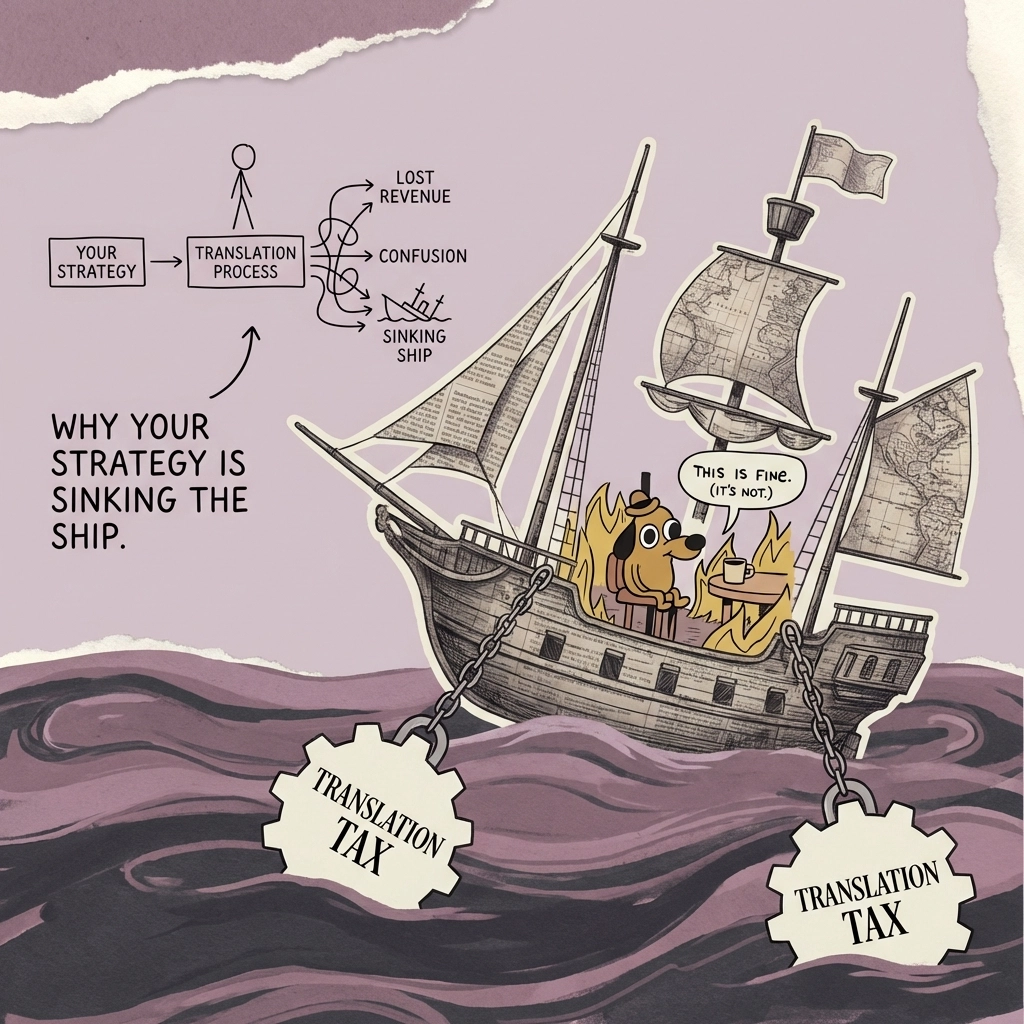
On August 10, 1628, the Swedish warship Vasa set sail from Stockholm harbor. She was supposed to be the crown jewel of King Gustavus Adolphus's fleet: the most heavily armed warship in the world. Instead, she sailed about 1,300 meters before tipping over and sinking like a very expensive stone.
The King wanted more cannons. The shipbuilders knew it wouldn't work. But somehow, between the royal decree and the shipyard floor, that critical engineering reality got lost in translation. The result? A 69-gun ship that was fundamentally too top-heavy to float properly, now sitting in a Stockholm museum as a $10 billion reminder (adjusted for inflation) that when business ambition and technical reality speak different languages, everybody drowns.
This exact same disaster plays out in modern conference rooms all the time—less water, more Slack notifications.

The Boardroom-to-Code Translation Problem
Every organization has its version of the Vasa moment. Leadership says, "More cannons"—more features, more AI, more speed. Reality says, "Physics exists." Meanwhile, someone is trying to explain a vibe to a spreadsheet, another person is translating emoji into a roadmap, and a third is nodding along while silently Googling acronyms.
Vision hears, "Make it legendary." Implementation hears, "Build a rocket ship out of LEGOs while the house is on fire."
Both perspectives are rational. The translation between them—that's where things sink.
This is what I call the Translation Tax: the hidden cost of turning "boardroom vibes" into "engineering deliverables" when nobody in the room speaks both languages fluently. It's the tax you pay when strategy and execution live in parallel universes, occasionally waving at each other through the glass but never actually meeting for coffee.
And just like the Vasa, the bigger your ambitions, the more catastrophic the failure when the translation breaks down.
The Math of Misalignment (Or: Why 10% Wrong = 100% Dead)
Here's the thing about translation taxes that would make Codie Sanchez proud: they're not just cultural problems, they're ROI killers with actual math attached.
On the Vasa, the King's directive—"more cannons"—was the ultimate Translation Tax: a goal expressed as a vibe and a noun, without the constraint set engineering needed. Ambition spoke; physics shrugged.
The Vasa teaches us that small misalignments in strategy create exponential failures in execution. The ship wasn't fundamentally broken: it was just optimized for the wrong constraints. The King optimized for "maximum cannons per ship." The physics optimized for "not immediately sinking."
In modern tech terms, I've seen this play out like:
10% misalignment between what the market wants and what engineering can deliver = 50% longer development cycles
20% misalignment between business goals and technical architecture = 200% increase in technical debt
30% misalignment between leadership vision and engineering capacity = Complete project failure (aka the full Vasa)
The Swedish learned this the hard way. According to the Vasa Museum archives, they actually tested the ship's stability before launch. The test involved having 30 men run back and forth across the deck to simulate combat conditions. After just three runs, the ship was rocking so violently they had to stop the test to avoid capsizing right there in port.
They launched anyway.
That's not an engineering problem. That's a translation problem.
Minimum Virtuous Product: Building Ships That Actually Float
The antidote to the Translation Tax isn't better communication (though that helps). It's building what I call Minimum Virtuous Product: the smallest possible version of your strategy that won't immediately sink when it hits reality.
Think of it like this: instead of trying to explain quantum physics to a golden retriever (the retriever will be confused, you'll be frustrated, and nobody gets fed), you build a bridge between the two worlds that works for both.
For the Vasa, this would have looked like:
1. Start with a ship that floats (technical constraint)
2. Add the minimum cannons needed for naval superiority (business constraint)
3. Test, measure, iterate (reality constraint)
4. Scale up only after proving the foundation works (sanity constraint)
Instead, they optimized for maximum political impact on day one, which is like trying to optimize a soufflé for dramatic effect: you might get the drama, but you definitely won't get to eat it.
The Hidden ROI of "Boring" Decisions
Here's where the Ann Handley empathy meets the Codie Sanchez math: the most profitable strategy decisions are often the most boring ones.
The Vasa failed because it prioritized spectacle over stability. But Sweden's earlier ships—smaller, less impressive, completely unstormy—dominated the Baltic Sea for decades because they were built to actually work, not to make a statement.
Teams that prioritize "boring" foundational work—solid data architecture, clear communication protocols, realistic timelines—consistently outperform teams chasing the shiny strategy of the month.
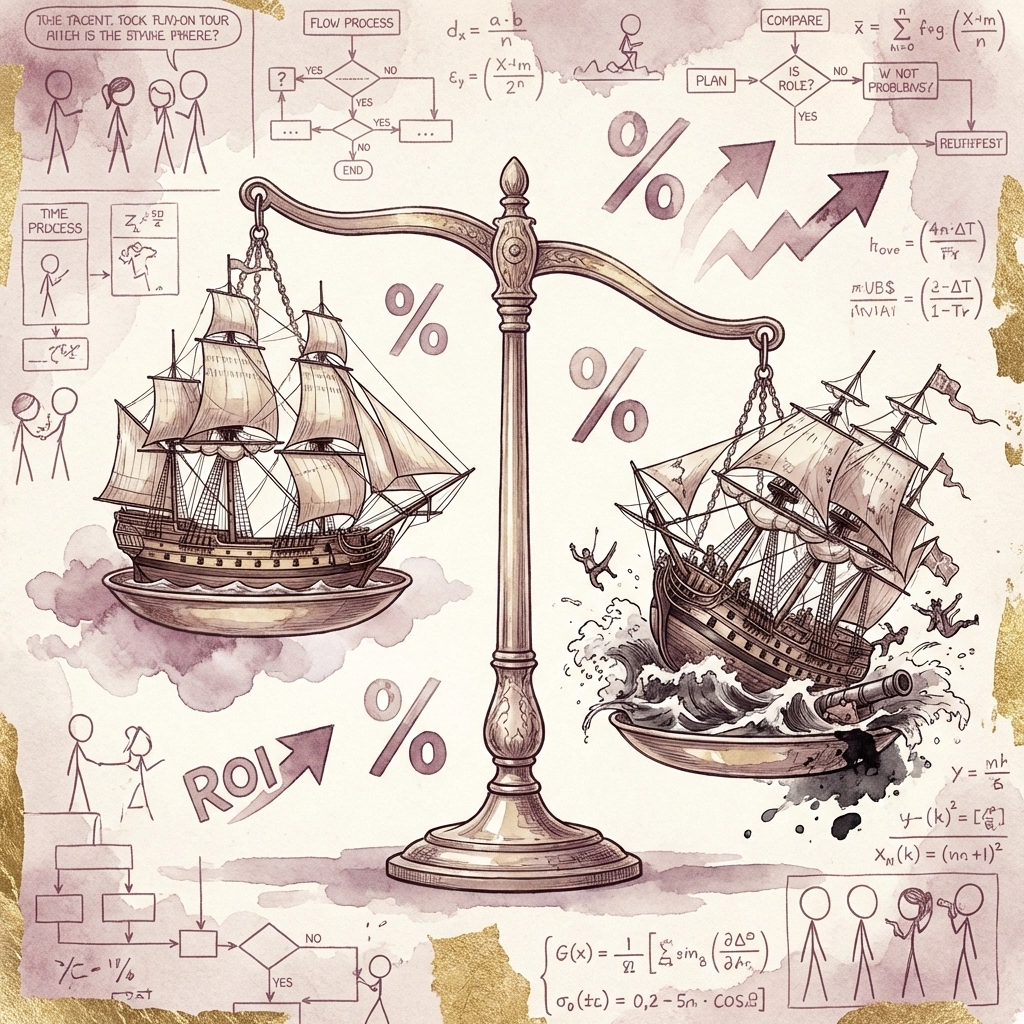
The math is simple: a 6/10 strategy executed at 9/10 beats a 10/10 strategy executed at 3/10, every single time.
That's the hidden ROI of boring: it actually ships. And shipping is the only strategy that generates revenue.
What "Good Translation" Actually Looks Like
Here's the practical part—because I'm a PM, and we don't get to just diagnose problems and walk away smugly. We have to actually fix them.
Good translation in practice looks like:
- Constraint sets, not wish lists. Instead of "make it faster," try "we need sub-200ms response times to compete with [specific competitor]."
- Trade-off conversations, not feature requests. Instead of "add this feature," try "if we add this, what breaks or gets delayed?"
- Shared vocabulary. Don't assume "scale" means the same thing to the CTO and the CFO. Define it. Together. In writing.
- Reality checkpoints. Build in moments to ask, "is this thing still floating?" before you've sailed too far from shore.
The Vasa builders knew the ship wouldn't work. They tested it. They saw the problem. But there was no safe mechanism for "hey, this is going to sink" to make it back up the chain.
Your translation system needs to include return postage.
The Magic Click Moment
When translation works, something beautiful happens. I call it The Magic Click: the moment where business goals and technical reality suddenly make sense to each other.
"Ohhhh. We're not building a 69-cannon ship. We're building a fleet that can dominate the Baltic. And the fastest way to do that is to start with ships that float."
That click is the moment strategy becomes executable. It's the moment the Translation Tax drops to zero.
And it's the moment your ship—or product, or company—stops being a $10 billion museum exhibit and starts being something that actually sails.
The Takeaway
The Translation Tax is invisible until it sinks you. The Vasa looked magnificent right up until it didn't.
The fix isn't more communication. It's better communication—the kind that bridges worlds instead of just broadcasting into them.
Build the bridge. Pay the translation cost upfront. Ship something that floats.
Your strategy will thank you.