
System Fatigue: Why Your Productivity Porn is Killing Your Profit
Why Your Productivity Porn is Killing Your Profit
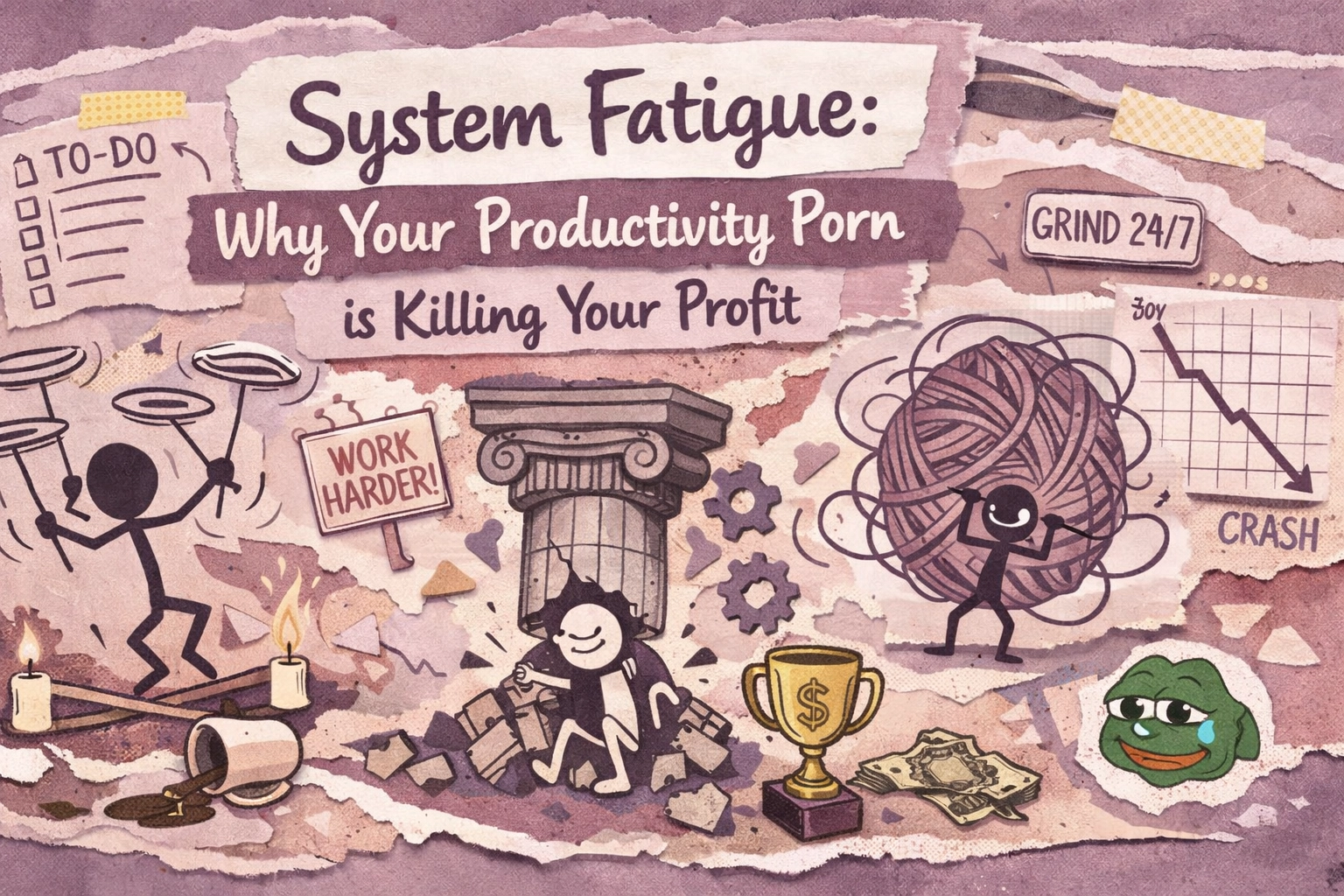
You have 14 productivity apps on your phone. Three different planners — one analog because a YouTuber swore handwriting rewires your brain. A Notion template you paid $97 for that promised to "10x your output." A morning routine checklist. A project management system with color-coded tags that nobody uses.
And you're still behind.
Here's why: You're not optimizing your work. You're optimizing your procrastination.
The Productivity Porn Trap
Let's call it what it is: productivity porn. It's the business equivalent of watching workout videos instead of going to the gym. You're consuming content about getting things done while doing absolutely nothing that moves the needle.
I see this pattern constantly with founders who hire me. They come in with elaborate systems: Asana boards with seventeen custom fields, automated Slack workflows, morning routines that require waking up at 4:47 AM (because 4:45 is "too mainstream"). They've read Atomic Habits three times. They can quote David Allen's GTD methodology verbatim.
And they're flat broke.
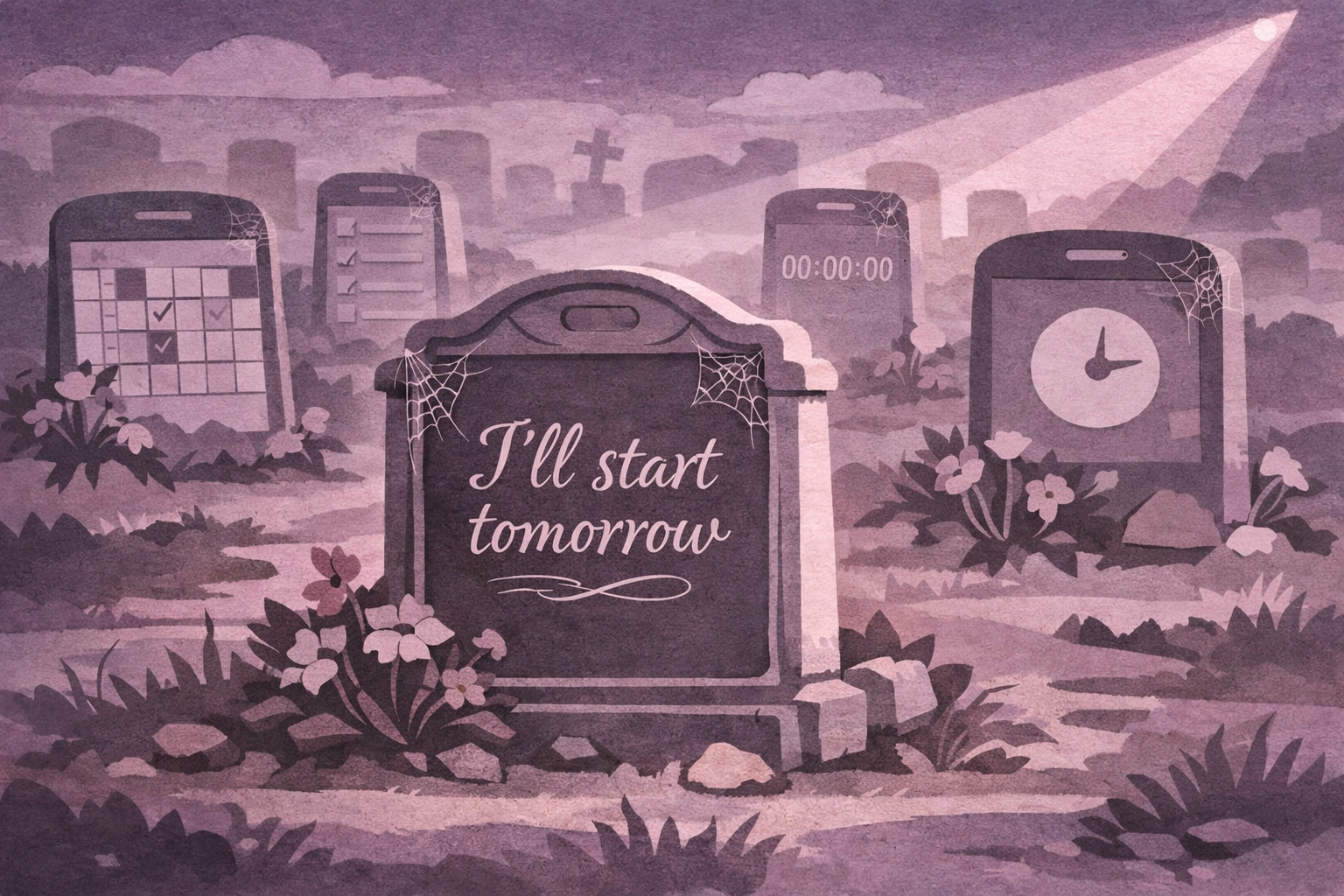
The core issue? Systems aren't supposed to feel like work. If your productivity system requires discipline to maintain, you don't have a system. You have a second job. And this one doesn't pay.
What Toyota Knows That You Don't
Let's talk about Toyota for a second. In the 1950s, Taiichi Ohno developed the Toyota Production System (TPS) — the foundation of what we now call Lean manufacturing. Toyota didn't become the world's largest automaker by working harder. They got there by systematically removing muda — waste.
Ohno identified seven types of waste in manufacturing. But here's the one that matters for your productivity crisis: overprocessing. Doing more work than necessary. Creating more elaborate systems than the output requires.
Sound familiar?
Your 20-page Standard Operating Procedure PDF? Nobody's reading it. Studies show that most SOPs have a compliance rate under 30% after the first month. You spent three weeks documenting a process that takes ten minutes to complete. That's not efficiency. That's self-sabotage dressed up as professionalism.
Toyota's solution was elegant: make the system so simple that following it requires less effort than ignoring it. They put tools exactly where workers needed them. They created visual cues that made the correct action obvious. They removed decision-making from routine tasks.
They built the machine. Not the motivation.
Systems vs. Aspiration: The Only Framework That Matters
Here's the difference that separates profitable founders from perpetual starters:
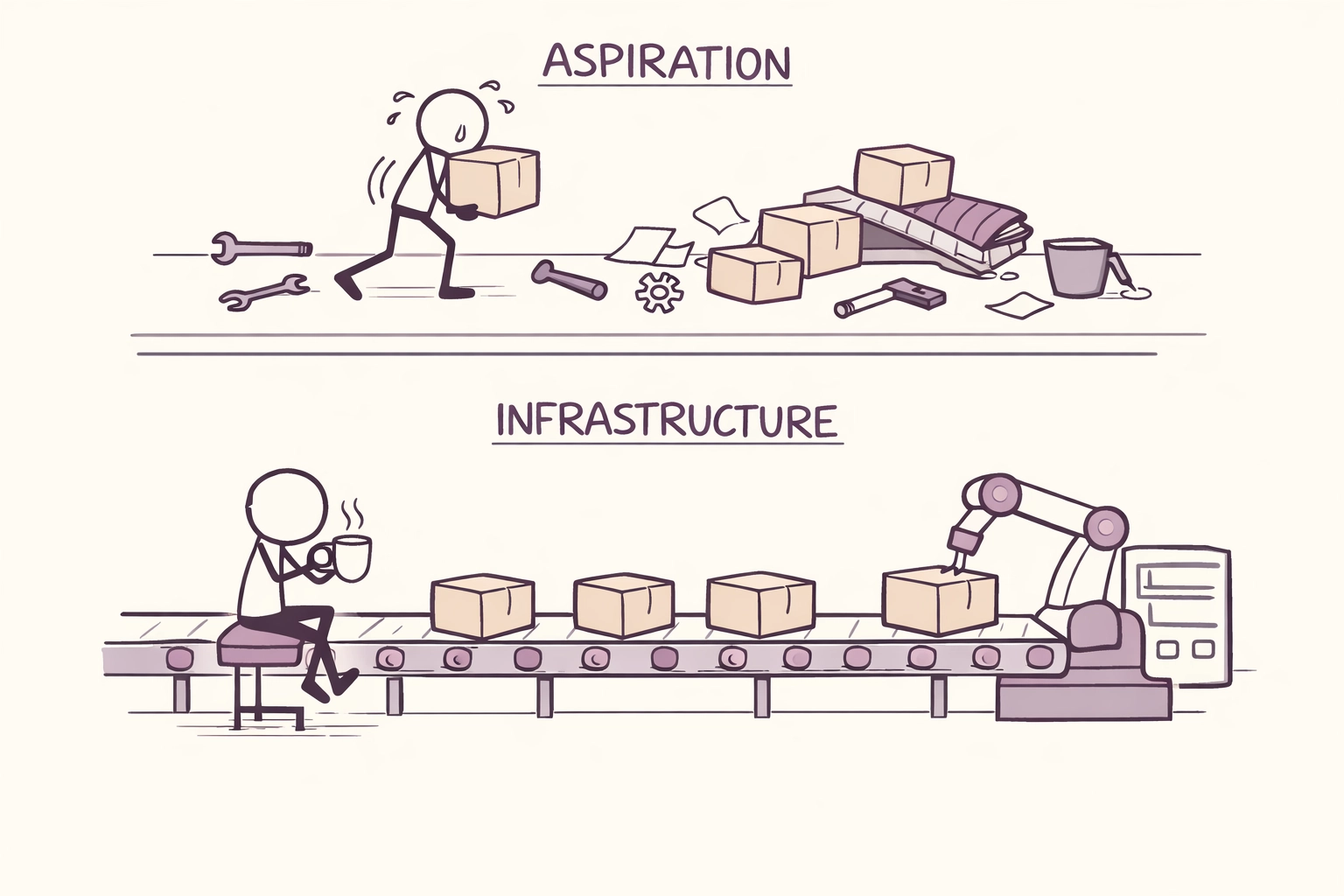
Aspiration: "I will review my quarterly goals every Monday morning at 6 AM with a cup of green tea while the sun rises."
Infrastructure: Your calendar blocks Monday 6-6:30 AM automatically. The quarterly goals document opens on your screen when you unlock your computer. Your tea maker is on a timer.
Aspiration relies on willpower. Infrastructure removes the decision entirely.
I worked with a founder last year who was "too busy" to hire. He had a hiring process — complete with a rubric, interview questions, and a scoring matrix. Beautiful. Professional. Totally useless.
Why? Because executing the process required him to:
- Remember to check the job posting
- Manually screen 40+ applications
- Schedule interviews via back-and-forth email
- Remember to send the assessment
- Manually score responses
Each step required discipline. Each step was a friction point. So what happened? He'd start the process, get overwhelmed, and ghost candidates. Then he'd beat himself up for "lack of discipline." Then he'd buy another course on "hiring for A-players."
The fix? We built the actual system:
- Application forms auto-filtered by knockout questions
- Calendar link embedded in the auto-response email
- Assessments triggered automatically after interview completion
- Scoring happened via structured forms, not memory
He hired three people in six weeks. Not because he suddenly developed superhuman discipline. Because the system removed the need for it.
The Financial Bloodletting You're Ignoring
Let's talk money, because that's what actually matters.
Every hour you spend researching productivity systems is an hour not spent on revenue-generating work. If your billable rate is $200/hour and you spend five hours this week watching YouTube videos about the Pomodoro Technique, that's $1,000 in direct opportunity cost.
But the real cost is steeper.
Cognitive fatigue from constant system-switching means you're operating at maybe 60% capacity during your actual work hours. You're context-switching between twelve open tabs — Trello, Notion, Google Tasks, that new AI tool that just launched — and your brain is exhausted before you start the work that pays.
Then there's the shame spiral. You see other founders crushing it on LinkedIn with their "perfect morning routines." You feel inadequate. You buy another course. The cycle continues.
I watched a coaching client spend $4,300 on productivity courses in one year. Her revenue? Flat. She had beautiful systems. Gorgeous documentation. A color-coded life.
And a business going nowhere.

The Pareto Principle You Keep Ignoring
The 80/20 rule isn't just for sales pipelines. It applies to your productivity stack too.
80% of your actual output comes from 20% of your tools.
Look at your productivity app folder right now. How many apps are just digital clutter? When was the last time you opened that habit tracker? That meal planning app? That meditation timer you downloaded after a particularly stressful Tuesday?
Most founders are running 10-15 productivity apps while actually using two. The rest are digital guilt — reminders of systems you abandoned and aspirations you haven't met.
Here's a gut-check: Can you explain your current productivity system on a napkin in under two minutes? If not, it's not a system. It's a monument to complexity.
Toyota could draw their entire production system on a single sheet of paper. You need three apps, two dashboards, and a PhD in project management to figure out what you're doing today.
The Way Forward: Subtraction, Not Addition
The solution isn't another app. It's not another course. It's not "finally getting disciplined this time."
The solution is ruthless subtraction.
Start here:
- Delete mercilessly. If you haven't used an app in 30 days, it's gone. No "I might need it someday." You won't.
- Automate the mundane. If you're manually doing something more than twice a week, automate it or delete it. Email filters. Calendar templates. Zapier workflows. Remove the decision.
- Build guardrails, not goals. Don't aspire to "check email twice daily." Set up auto-responses that tell people you check at 10 AM and 3 PM. Make the infrastructure enforce the behavior.
- One source of truth. Pick one system for tasks. One for notes. One for calendar. That's it. Three systems maximum. If it doesn't fit in those three, it doesn't belong in your life.
The goal isn't to become a productivity machine. The goal is to build a system so simple that productivity becomes the path of least resistance.
Stop optimizing your systems. Start optimizing your profit.
References:
- Ohno, Taiichi. Toyota Production System: Beyond Large-Scale Production. Productivity Press, 1988.
- Clear, James. Atomic Habits: An Easy & Proven Way to Build Good Habits & Break Bad Ones. Avery, 2018.
- Koch, Richard. The 80/20 Principle: The Secret to Achieving More with Less. Crown Business, 1998.