
The Perfectionism Pivot: Why Your 'High Standards' Are Actually Just Expensive Fear
Why Your 'High Standards' Are Actually Just Expensive Fear
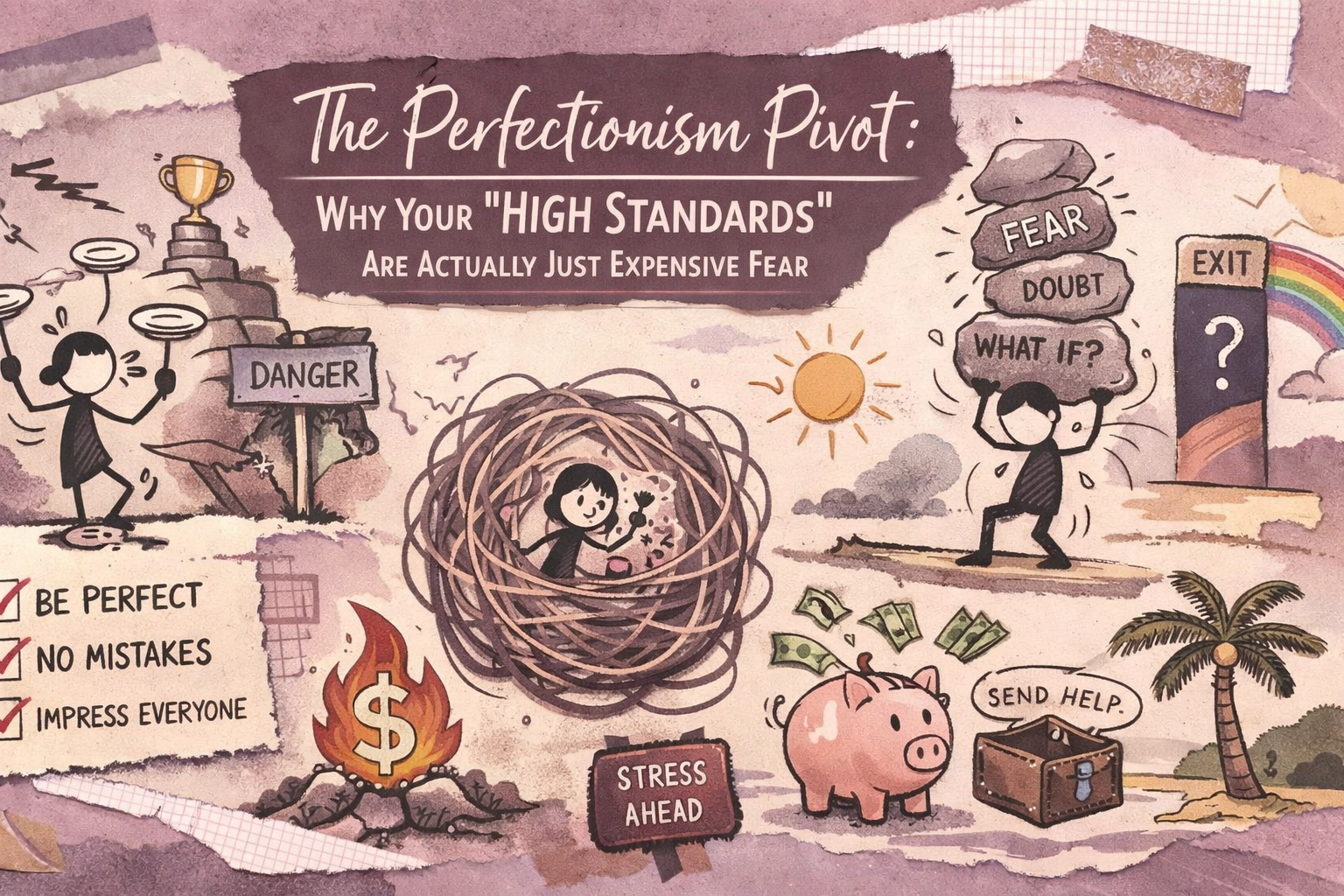
You call it "perfectionism." I call it "hiding."
Your high standards aren't a badge of honor. They're the most expensive form of fear you own. And they're bleeding you dry while you polish the railing on a ship that never leaves the harbor.
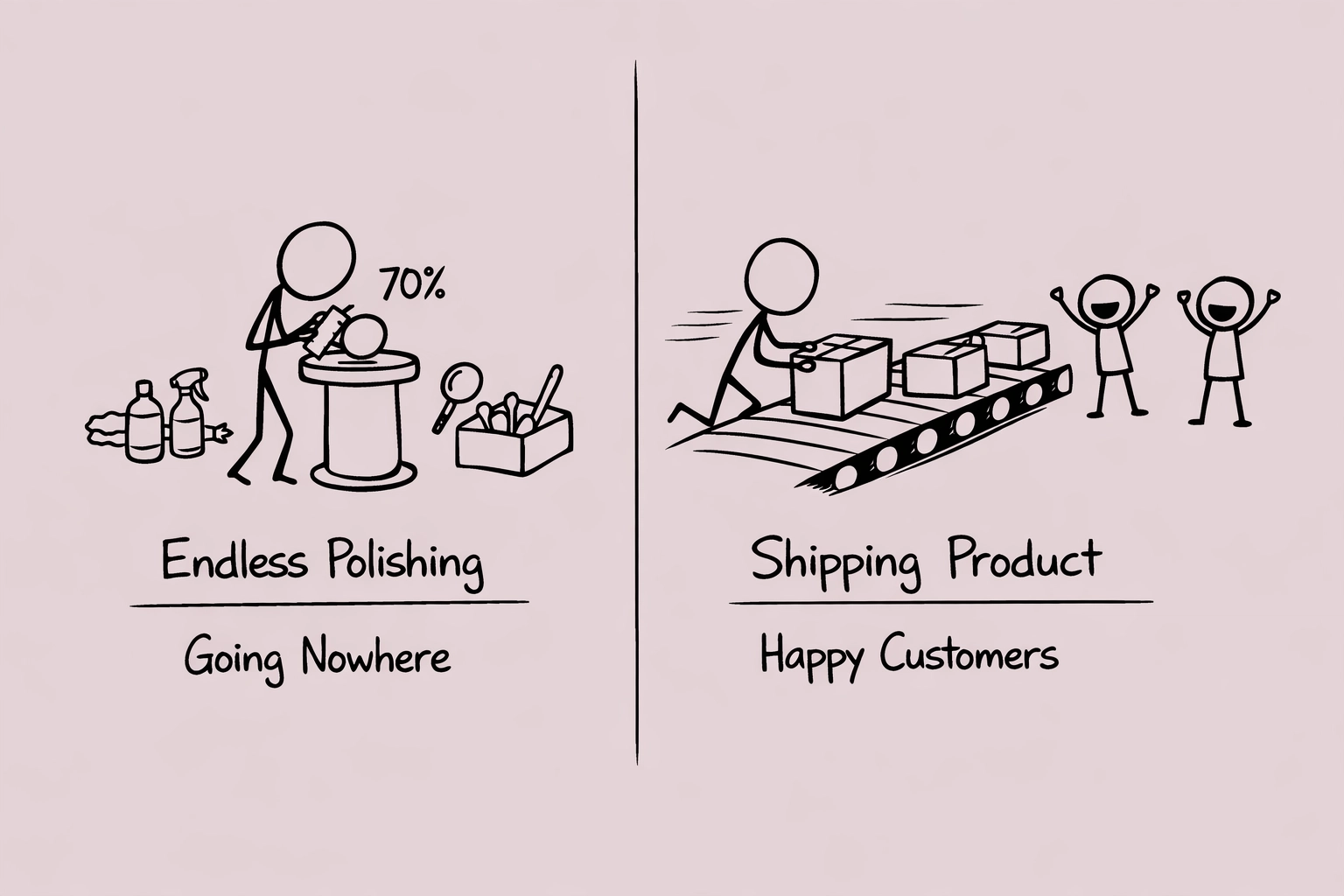
That product you've been "refining" for six months? It's not getting better. It's getting stale. Your idea isn't aging like wine. It's rotting like fruit. And every day you spend making it "perfect" is a day your competitor ships something 70% as good and takes the entire market you were "too principled" to serve.
The Difference Between Standards and Stalling
High standards are about creating something valuable. Perfectionism is about proving you're valuable. One is about the work. The other is a therapy session disguised as a project plan.
Try this: if you can't ship until it's "ready," you're not building a product. You're building a defense mechanism against being seen. Because if you never launch, you never fail. And if you never fail, you never have to sit with the terrifying possibility that you're not as exceptional as your LinkedIn bio suggests.

Reid Hoffman, the guy who built LinkedIn, said it best: "If you are not embarrassed by the first version of your product, you've launched too late."
Think about that. LinkedIn, the platform with 930+ million users, worth $26 billion when Microsoft acquired it, started as a janky networking tool that looked like a high school computer project. The early interface was clunky. Features were missing. It wasn't perfect. It was present.
Hoffman didn't wait until the algorithm was polished or the UX was smooth. He shipped a minimum viable product that could learn from real users. He understood something most high-achievers miss: The market doesn't reward your effort. It rewards your velocity.
The Billion-Dollar Counterexample
Want to see what happens when you prioritize perfection over presence? Meet Quibi.
Jeffrey Katzenberg and Meg Whitman raised $1.75 billion (with a "B") to launch a mobile-first streaming platform. They spent years developing "perfect" short-form content with A-list talent. Every detail was polished. The technology was the latest that money could buy. The content was premium.
They shut down six months later.
All that money. All those "high standards." And nobody wanted it. They built what they thought the market needed instead of shipping fast enough to learn what it actually wanted.
Quibi is the cautionary tale every perfectionist should have tattooed on their forearm. Expensive and polished loses to scrappy and responsive. Every single time.
The Real Cost of Your "High Standards"
Let's talk about what your perfectionism is actually costing you. Because it's not just time.
It's revenue. That B- product you won't ship? It could be generating $10K/month right now while you "refine" it. Multiply that by the six months you've been stalling. That's $60K you've left on the table for the privilege of feeling virtuous about your process.
Then there's momentum. Every day you don't ship is a day you don't get customer feedback. And customer feedback is the only thing that makes your product actually better. Not your internal monologue about font choices.
But the worst cost is psychological. Perfectionism isn't a personality trait. It's a fixed mindset wearing a designer suit. Carol Dweck's research on fixed vs. growth mindsets shows that perfectionists tie their worth to flawless performance, so they avoid any situation where they might look less than exceptional. Translation: they hide behind "not ready yet" until the window closes.
And even when you do finally launch something, you can't enjoy it. The internal narrative shifts immediately to "that could have been better." You hit a major milestone and instead of feeling proud, you feel deflated. You've stolen the only reward that actually matters from yourself.
The 70% Rule: Your New Operating System
If you're 70% sure and 70% ready, go.
The remaining 30% isn't learned in your Notion board. It's learned in the trenches, with real customers, real feedback, and real money changing hands. That final 30% polish you're obsessing over? Your customers don't care. They care whether you solve their problem today, not whether you solve it elegantly six months from now.
So stop treating your work like a dissertation that needs to be defended. Treat it like a conversation that needs to be started.
Jeff Bezos frames this well with his "Type 1 vs. Type 2 decisions" model. Type 1 decisions are one-way doors, hard to reverse, high stakes. Type 2 decisions are two-way doors, easily reversible, low risk.
Most of what you're perfecting? Type 2 decisions. You can change the pricing. You can update the messaging. You can iterate the features. But you're treating them like Type 1 decisions because it gives you permission to stall.
Ship the imperfect thing. Learn from the market. Adjust. Then do it again. That's the actual high standard: not perfection, but relentless iteration.
The Pivot: From Fear to Freedom
What does this look like when you actually do it?
Before: Spending three weeks designing the "perfect" email sequence before launching a product. After: Writing three emails in an afternoon, sending them to your list, and adjusting based on open rates and replies.
Or take the person who built a 47-page business plan before testing their service offering. They could have offered a beta to three clients and shaped the real offer from their feedback. Would have taken a week instead of a quarter.
And the classic: waiting until you "feel ready" to raise your prices. You'll never feel ready. Raise them next Monday. The market will tell you whether it agrees. (Spoiler: it usually does.)
The shift isn't about lowering your standards. It's about redirecting your energy from avoiding judgment to creating value. Because the dirty secret is that nobody is judging you as harshly as you're judging yourself. They're too busy trying to solve their own problems, which is exactly what your imperfect product could be doing right now.

The Real Badge of Honor
Perfectionism pretends to be excellence, but it runs on fear. And fear, no matter how articulate, no matter how well-dressed as "high standards," is expensive. It costs you revenue, momentum, learning, and the thing that actually makes you matter to other people: being there. Showing up. With something real, even if it's rough.
Your messy, flawed, 70%-ready work will always have more impact than the perfect idea trapped in your head. Because you can't help anyone from inside your own skull.
So ship the thing. Embarrass yourself a little. Learn a lot. Iterate fast.
The launch button is right there. It's dirty. It's cracked. It's imperfect.
Press it anyway.
References & Further Reading
- Reid Hoffman – "Blitzscaling: The Lightning-Fast Path to Building Massively Valuable Companies" (on the speed of shipping and minimum viable products)
- Carol Dweck – "Mindset: The New Psychology of Success" (exploring fixed mindset traits like perfectionism vs. growth mindset approaches)
- Jeff Bezos – Annual Shareholder Letters, particularly on "Type 1 vs. Type 2 Decisions" and reversible vs. irreversible choices
- Anne Lamott – "Bird by Bird: Some Instructions on Writing and Life" (on shipping 'shitty first drafts' and the creative process)
- Quibi Case Study – Harvard Business Review analysis of the $1.75B streaming failure