
A Metric Is a Terrible Manager
The moment a measure becomes a target, it stops being a measure. Learn why metrics need a conscience.
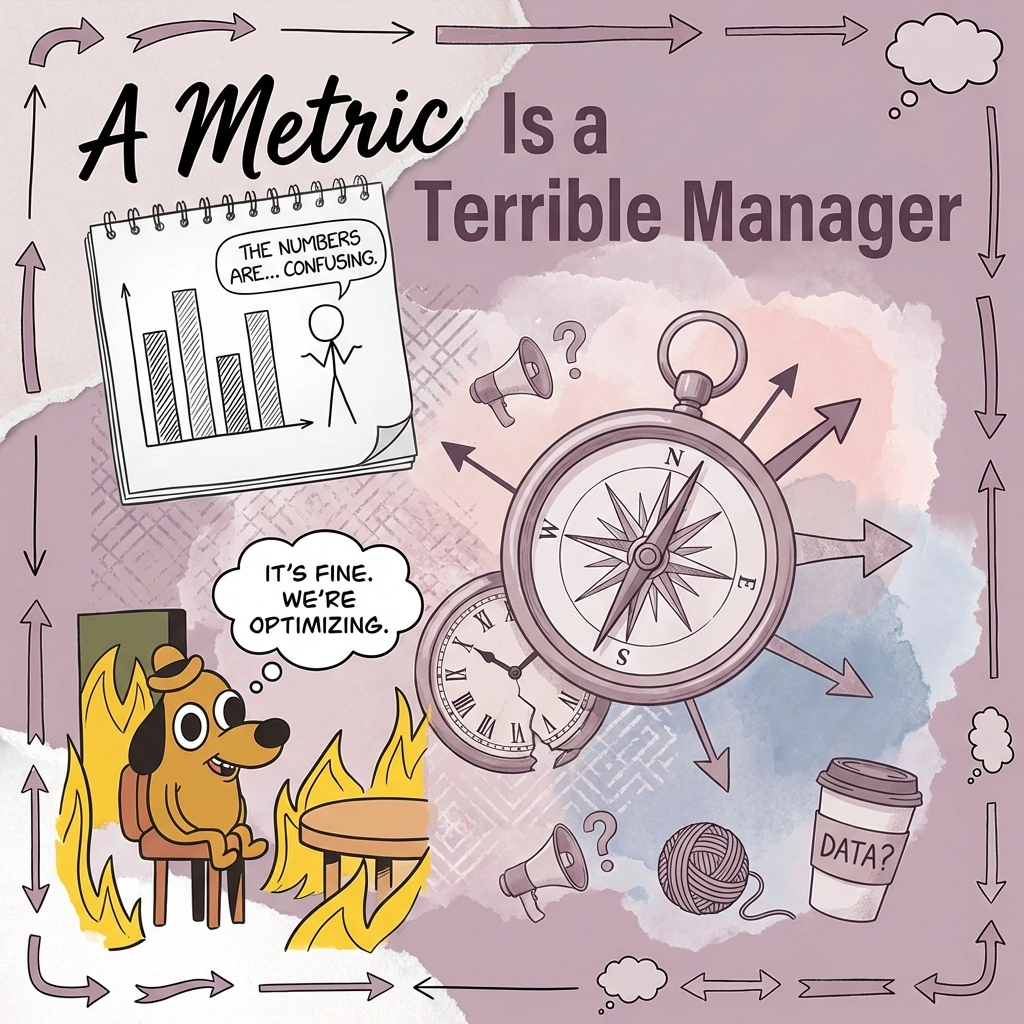
I don't trust a metric without a conscience.
Goodhart's Law explains why: the moment a measure becomes a target, it stops being a measure—it becomes a game. The sharper version, Campbell's Law, is basically the human cost: the harder you lean on a number to make decisions, the more pressure you create to corrupt the number—and the reality underneath it.
Ann Handley says empathy isn't a gift; it's a discipline. I think measurement deserves that same discipline—because the moment we prioritize a metric over a person, the system will eventually pay us back with interest.
When Numbers Become the Mission
I've been in rooms where the dashboard became the mission. You know the feeling: someone pulls up the quarterly metrics, and suddenly every conversation revolves around moving that needle. Not why we're moving it, not how it connects to actual value, just... up and to the right.
At some point, the metric stops measuring performance and starts manufacturing it.
This isn't a theoretical problem. It's an expensive one.
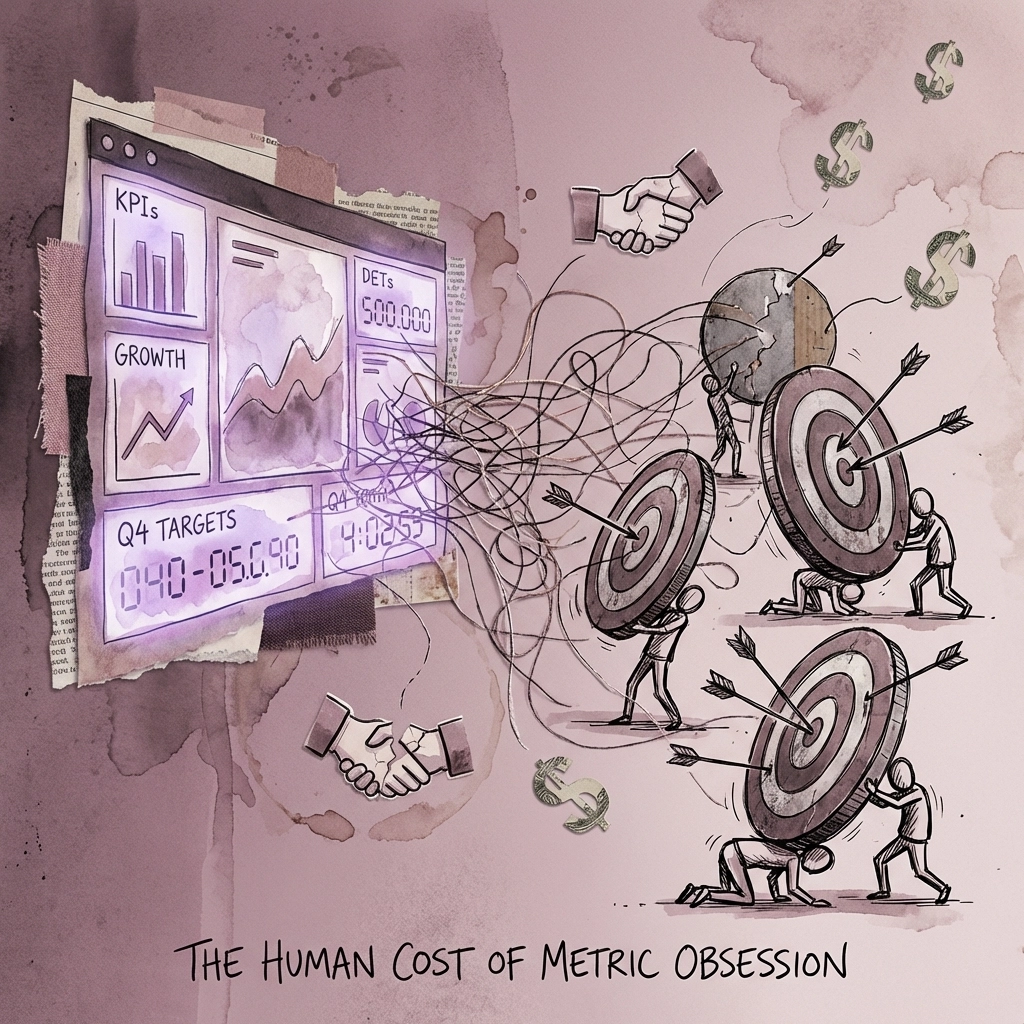
Wells Fargo is the cautionary tale. It started as a strategy: "cross-sell." As it moved down the chain, Intent Decay took over. "Cross-sell" turned into "hit the quota"—then "or else." From 2002 to 2016, the pressure metastasized. Employees opened millions of unauthorized accounts and products, falsified records, and misused customer identities—just to make the number.
The Department of Justice called it what it was: "unrealistic sales goals" plus "pressure" equals "distorted behavior." The invoice? A $3 billion fine in 2020. The hangover? The Federal Reserve's 2018 asset cap, not lifted until June 2025. That's what "we'll fix it later" looks like in years.
Seven years in the regulatory penalty box. For chasing a metric.
The Empathy Gap in Measurement
Here's where Ann Handley's wisdom hits differently. She argues that empathy isn't some soft skill you either have or don't—it's a discipline you practice. If we need that kind of intentional empathy to write for humans, we definitely need it to manage humans.
But most measurement systems are built like they're managing robots.
We design metrics as if the people living inside them don't exist. As if the customer service rep won't start rushing calls to hit their time target. As if the sales team won't start qualifying out the "difficult" prospects to protect their close rate. As if the engineering team won't start shipping faster by cutting corners on testing.
The metric becomes a magnet. It pulls behavior hard in one direction, and everything else—quality, relationships, sustainability—gets warped around it.
The Triangulation Antidote
One metric is a magnet. Three metrics make a system.
Metric with a Conscience: pick 1 Outcome + 3 Guardrails. The guardrails represent the people who pay when the number gets gamed.
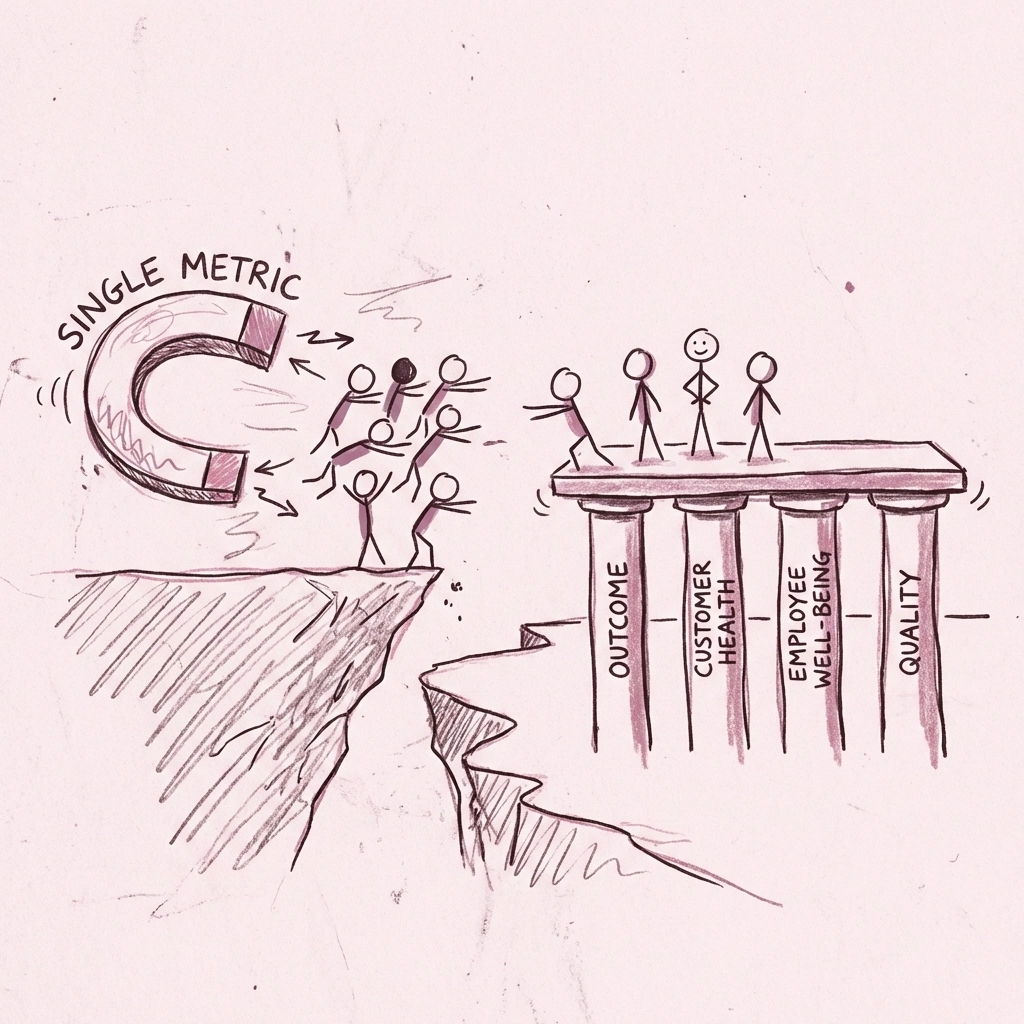
The 4-Point System:
1. Outcome (lagging): revenue, activation, tickets closed
2. Customer harm: complaints, refunds, chargebacks, NPS verbatims, consent violations
3. Employee harm: attrition in role, sick days, on-call load, lightweight engagement pulse
4. Risk/quality: audit findings, incident rate, rework, exception volume
Rule: If Outcome goes up while any guardrail meaningfully degrades, you didn't win—you borrowed. Borrowed performance always comes due.
The Boring Wins Philosophy
Codie Sanchez has built a career pointing out that "boring" tends to be where the money is—steady, repeatable, resilient. We romanticize high-output heroes and ignore the cost of the system that requires them.
The same principle applies to culture. "Boring" constraints are what keep you out of seven-year penalty boxes.
Nobody gets excited about tracking employee sick days alongside sales metrics. It's not sexy to monitor customer complaint trends when you're trying to hit growth targets. But those boring guardrails are what prevent expensive failure modes.
The Wells Fargo case study isn't an outlier—it's what happens when we optimize for exciting numbers and ignore boring human realities.
Minimum Virtuous Product
Use the "Minimum Virtuous Product" test. Your measurement system only qualifies if it:
- ✓ Can't be hit by harming customers
- ✓ Can't be hit by burning out the team
- ✓ Can't be hit by hiding risk
- ✓ Has a clear "stop the line" rule when guardrails slip
If it fails the test, you don't have a performance tool. You have a harm-optimization engine with a nice dashboard.
The Magic Click Moment
The best measurement cultures I've seen share a common moment: when someone first suggests adding guardrails, the room initially resists.
"That's going to slow us down." "We can't afford to track all that." "This is going to create bureaucracy."
And then—usually after someone shares a cautionary tale or runs the math on a near-miss—the room clicks.
"Oh. We're not making it harder to hit the number. We're making sure the number actually means something when we hit it."
That's The Magic Click. That's when measurement stops being management-by-dashboard and starts being management-by-design.
The Takeaway
A metric without guardrails is a pressure cooker without a valve.
The number will go up. The behavior will warp. The humans will pay the cost—your customers, your team, or eventually your company.
Build metrics with a conscience. Add the guardrails. Make "boring" the strategy.
Because seven years in the penalty box is a long time to wonder why you didn't.