
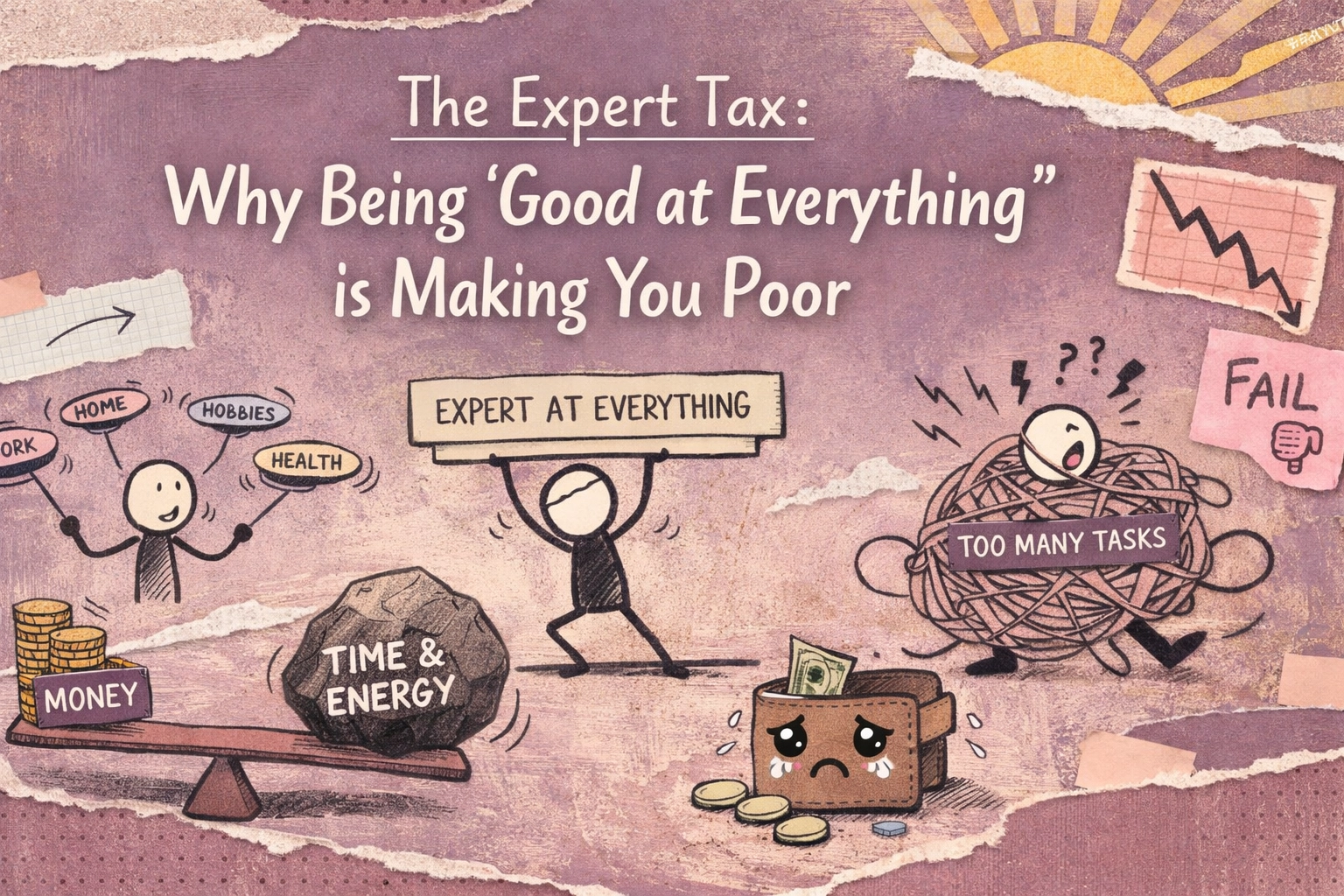
The Expert Tax: Why Being "Good at Everything" is Making You Poor
Why Being "Good at Everything" is Making You Poor
You're not talented.
You're trapped.
That "I can do it myself" badge you wear? It's expensive. Like, six-figures-left-on-the-table expensive.
Let me tell you about Sarah.
She ran a consulting firm. Seven figures in revenue. Built a gorgeous website herself. Wrote all her own copy. Managed her own CRM. Set up her own funnels. Fixed her own tech issues at 11 PM on Sundays.
She was good at all of it.
Which is exactly why her business plateaued.
The Competence Trap Costs More Than You Think
Here's what Sarah didn't calculate: while she spent 6 hours building a landing page (because she could), she didn't spend those 6 hours closing a $50K contract.
The math isn't pretty.
Her hourly rate for client work? $500.
Her effective hourly rate while doing her own web design? Maybe $50, if we're generous.
She paid herself $450 less per hour. Repeatedly. For months.
Michael Gerber called this out in The E-Myth Revisited: most entrepreneurs aren't building businesses. They're building jobs for themselves. Stuck as "The Technician." Doing the work in the business instead of working on it.
And it gets worse as you scale.
Because once you have even a tiny team, there's a hidden surcharge: Intent Decay.
You say: "We need a simple onboarding flow."
It travels through Slack, Asana, a meeting, a follow-up meeting, and someone's "quick question."
It arrives as: "So… do we rebuild the whole portal?"
That's the translation tax. The cost of your brain getting diluted by the org.
I learned this the hard way leading cross-cultural teams in high-stakes environments. Different time zones. Different defaults. Different definitions of "urgent." One stakeholder hears "tighten quality" and thinks "add process." Another hears the same thing and thinks "ship slower." Meanwhile you're in the middle, trying to keep the intent intact while not offending anyone.
If your intent doesn't have structure — clear owners, decision rules, written specs, a review cadence — it decays. Fast.
And guess who becomes the human patch for that decay?
You.
Which is how you end up being "good at everything."
Not because you love it.
Because it's the only way anything stays coherent.

Sarah wasn't an entrepreneur. She was an expensive freelancer with a business card.
You're Not Saving Money. You're Stealing It.
Let's reframe this.
Every hour you spend doing $25/hour work is an hour you're not spending doing $500/hour work.
That's not frugal. That's theft.
You're stealing from your business. From your future self. From the version of your company that could actually scale.
Dan Sullivan nailed it in Who Not How: The moment you ask "How do I do this?" instead of "Who can do this for me?", you've already lost.
Because you're not just trading time. You're trading leverage.
The 80/20 rule isn't just about productivity. It's about founder energy. Twenty percent of your activities generate 80% of your results. But if you're doing everything, you're diluting that 20% into oblivion.
Sarah was competent at 15 things.
She should've been exceptional at 2.
The $1M Idea That Died in a Spreadsheet
Here's the part that keeps me up at night.
While Sarah was updating her email sequences, she had an idea for a new service offering. High-ticket. Repeatable. The kind of thing that could've added $1M in annual revenue.
She wrote it down.
She put it in a folder called "Future Projects."
Then she went back to fixing a broken Zapier integration.
That idea? Still in the folder. Two years later.
Not because she wasn't smart enough. Not because she didn't have the expertise.
Because she was too busy being the Chief Everything Officer.
The real tragedy? She thought she was being responsible. Strategic. Scrappy.
She was being expensive.
The Product CEO Paradox (aka: "Congrats, you're the bottleneck")
Let me give you a founder story you'll recognize in your bones.
Call him Jay.
Jay's a high-achiever. Ex-operator. Moves fast. Taste level is offensive (in the best way). His product is great because he is great.
In the beginning, it's magic:
- Every decision is quick.
- Every customer request gets handled.
- Every edge case gets solved.
- Every doc lives in Jay's head. (Classic.)
Then the team grows.
And suddenly every sentence starts with: "Ask Jay."
Design? Ask Jay. Copy? Ask Jay. Pricing? Ask Jay. Hiring? Ask Jay. Customer escalation? Ask Jay. "Hey Jay, quick question" (the eight most expensive words in business).
Jay isn't trying to micromanage.
He's trying to protect the product.
This is what Ben Horowitz calls the Product CEO Paradox: the founder who must stay close to product quality becomes the choke point that prevents the company from moving. Swing too far the other way? Quality craters. It's lose-lose. Unless you build the machine that holds quality without you in the room.
What Jay needed wasn't "better discipline."
It was a system that prevented Intent Decay:
- Written specs instead of vibes
- A weekly product review cadence (not hallway drive-bys)
- Decision rights that don't require CEO approval for every pixel
- A clear "what good looks like" rubric so quality isn't a personality trait
Once Jay installed that, the team stopped summoning him like a genie.
He got his brain back.
And the company finally sped up without shipping garbage.
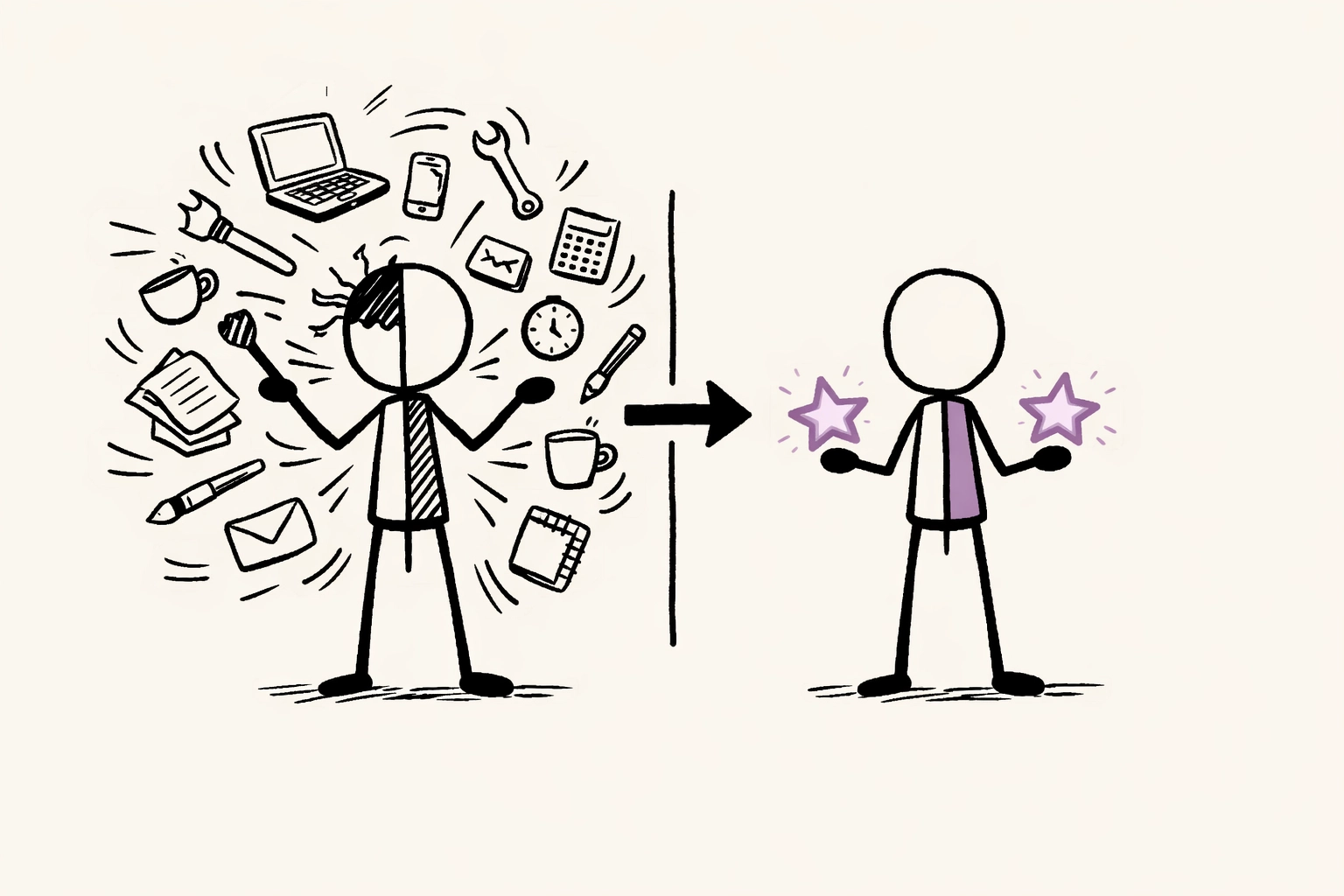
If You're the Most Competent Person for Every Task, You've Built a Prison
Let's get uncomfortable.
Your ability to "do it all" isn't a competitive advantage. It's a liability.
Think about it: If your business requires you to write the copy, build the funnels, manage the operations, handle customer service, and still somehow sell and deliver your core offer...
You don't have a business. You have a cage.
Gerber breaks this down into three roles every business needs:
The Technician does the work. The Manager organizes the work. The Entrepreneur envisions the future.
Most founders are 70% Technician, 20% Manager, and 10% Entrepreneur.
That ratio should be flipped.
But here's the trap: You got good at being the Technician. You got rewarded for it. Early on, your ability to execute was the business.
But now? That skill is the anchor dragging you to the bottom.
Stop Being the Machine. Start Owning the Machine.
I'm not talking about buying another project management tool or a fancier CRM.
I'm talking about the people and processes that free you from doing the $25/hour work. The guardrails that keep your intent from getting mangled as it passes through more humans.
It's the "Who" that replaces the "How."
Sarah finally figured this out. She hired a VA. Then a copywriter. Then a junior ops person.
Know what happened?
She closed two $75K deals in one quarter. Because she finally had time to sell.
Her revenue went up 40%. Her hours went down 30%.
The math started working in her favor.
The Cautionary Tale: When Ambition Outpaces the Machine
If you think systems are optional, let me tell you about a place that had plenty of talent and plenty of ambition.
Wells Fargo.
After years of aggressive growth and sales pressure, the U.S. Federal Reserve dropped a hammer in 2018: a consent order that restricted Wells Fargo's growth by capping its total consolidated assets at the level it held at December 31, 2017 (about $1.95T). No more "just grow through it." Not until governance and controls were fixed.
That's what it looks like when the grown-up world shows up and says:
"You don't get to scale chaos."
And the downstream consequences didn't stay theoretical. The DOJ later summarized Wells Fargo's $3B settlement tied to its sales practices (including the opening of millions of accounts without customer authorization). Not a "whoops." A systems failure that got normalized, defended, and scaled.
This is the point:
Ambition is not the problem.
Ambition without the systems to hold it is the problem.
Because when pressure rises, whatever you've built underneath you gets stress-tested.
- Incentives get gamed.
- Quality collapses.
- People hide bad news.
- Intent Decay turns "do the right thing" into "hit the number."
If a trillion-dollar company can get growth-capped for weak controls, your business can absolutely get capped too.
Not by the Fed.
By reality. By refunds. By churn. By team burnout. By you becoming the permanent bottleneck.

The Sports Car Pulling a Plow
Imagine taking a Porsche 911 and hooking it up to a plow.
It could pull the plow. The engine's powerful enough.
But that's not what it's built for. You're not leveraging its design. You're wasting a $200K machine on a $20K job.
That's you. Every time you say "I'll just do it myself."
You're the Porsche. The admin work is the plow.
And you're wondering why you're not going faster.
What This Actually Costs You
Let's do the real math.
Say you spend 10 hours a week on tasks someone else could do for $25–$50/hour. That's $500/week in labor costs if you outsource.
But your client-facing, revenue-generating work is worth $500/hour.
By doing it yourself, you're "saving" $500/week.
But you're losing $5,000/week in opportunity cost.
That's $260,000 per year.
For what? To feel indispensable?
The Identity Shift You Need
The hardest part isn't hiring someone.
It's letting go of the identity of "the person who can do it all."
You got here because you were competent. Because you figured it out. Because you were scrappy.
But scrappy doesn't scale.
The version of you that built the business isn't the same version that's going to grow it.
Sullivan's entire philosophy is built on this: Stop asking "How do I do this?" Start asking "Who's already great at this?"
Your job isn't to be good at everything.
Your job is to be great at finding people who are great at the things you shouldn't be doing.
The Reframe That Changes Everything
Here's the shift:
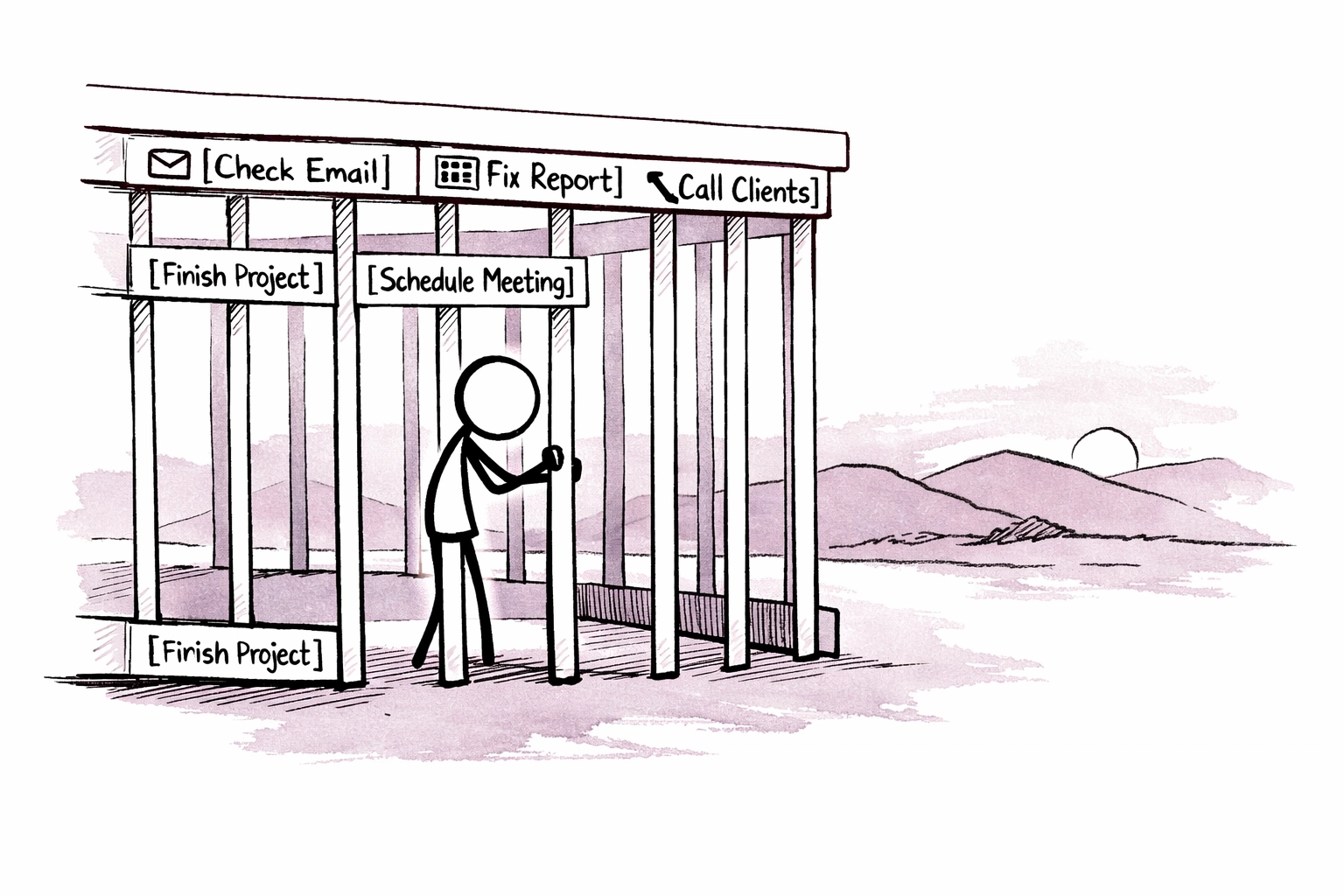
Doing it yourself isn't noble. It's negligent.
You're not being a "team player" by handling the grunt work. You're depriving your business of your highest-value contribution.
You're not being "hands-on." You're being a bottleneck.
Every task you can do but shouldn't do is a tax on your business. An invisible expense that doesn't show up on your P&L but bleeds your growth potential dry.
Call it the Expert Tax.
The price you pay for being competent at things that don't move the needle.
What to Do About It
Step 1: Audit your week. Write down every task. Every single one.
Step 2: Mark what only you can do. Strategy. Vision. Key relationships. High-stakes sales. That's probably 20% of your list.
Step 3: Hire for the rest. Not eventually. Now.
Step 4: Train yourself out of the Technician role. Your discomfort with delegating is just ego. Let it go.
Sarah's firm is on track to hit $2M this year. Not because she got better at design or copywriting.
Because she stopped doing them.
She fired herself from the jobs she was "good at" so she could focus on the job she was built for.
That's not laziness. That's leverage.
And leverage is how you stop being poor.
The question isn't whether you're capable. Of course you are.
The question is: What's it costing you to prove it?
References
- Ben Horowitz, "Why Founders Fail: The Product CEO Paradox" (a16z). a16z.com
- Michael Gerber, The E-Myth Revisited.
- Federal Reserve Press Release (2018) regarding Wells Fargo's consent order and asset cap. federalreserve.gov
- DOJ Summary of Wells Fargo's $3B settlement for sales practices. justice.gov
- Dan Sullivan, Who Not How.