
The Discipline Delusion: Why Your Willpower is a Bad Investment
Why Your Willpower is a Bad Investment
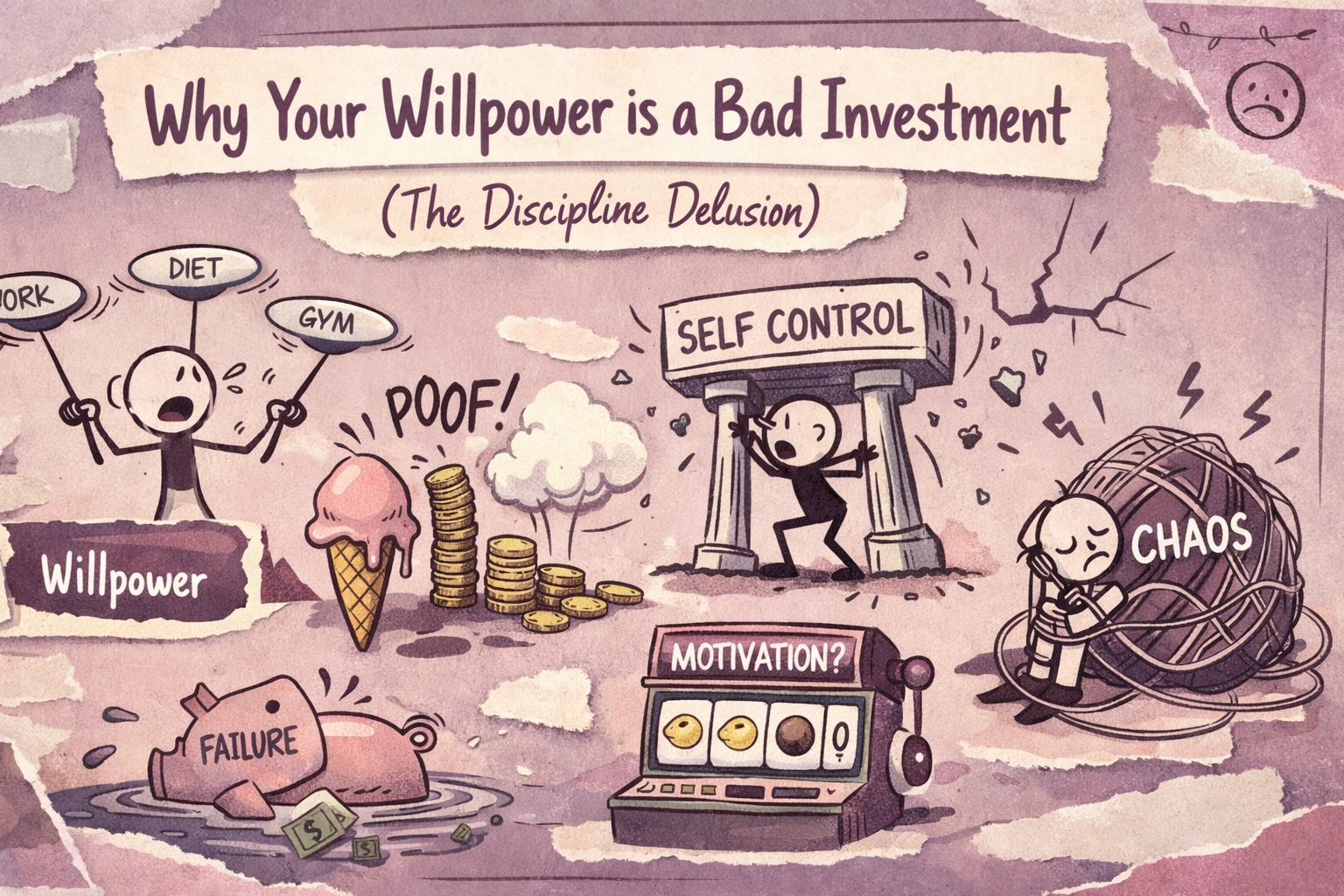
I know a founder who works 14-hour days.
Every single day.
No breaks, no systems — just raw willpower and a metric ton of coffee.
He thinks this makes him disciplined.
I think it makes him expensive.
Because here's what nobody tells high-achievers: Your willpower is the most expensive resource in your business.
And you're burning it on tasks a $25/hour VA could handle.
The Hero Complex is Bankrupting You
Let me paint you a picture.
You wake up at 5:47 AM (because 6 AM is for amateurs). You meditate. Cold shower. Green smoothie. Inbox zero by 7:30. You're crushing it.
By 2 PM, you're eating stale crackers over your keyboard and can't remember if you responded to that investor email.
By 8 PM, you're rage-scrolling Twitter and ordering DoorDash for the third time this week.
What happened?
Decision fatigue happened.
Roy Baumeister's research on ego depletion showed that willpower isn't just finite: it's depletable. Every decision you make, every task you "power through," every email you force yourself to answer drains the same psychological resource.
You're not lazy when you fall apart at 3 PM.
You're just out of gas.
The Intellectual Arrogance Tax
Here's the thing high-performers won't admit: Thinking you can willpower your way through everything is actually arrogance disguised as work ethic.
You believe you're special enough to not need systems. That discipline alone will scale. That "just focus harder" is a business strategy.
It's not. It's a tax on your time, your health, and your actual intellectual capacity.
James Clear nailed this in Atomic Habits: "You do not rise to the level of your goals. You fall to the level of your systems."
Put differently: your willpower will fail you. Your systems won't.
The Checklist Principle (Or: Why Pilots Don't Wing It)
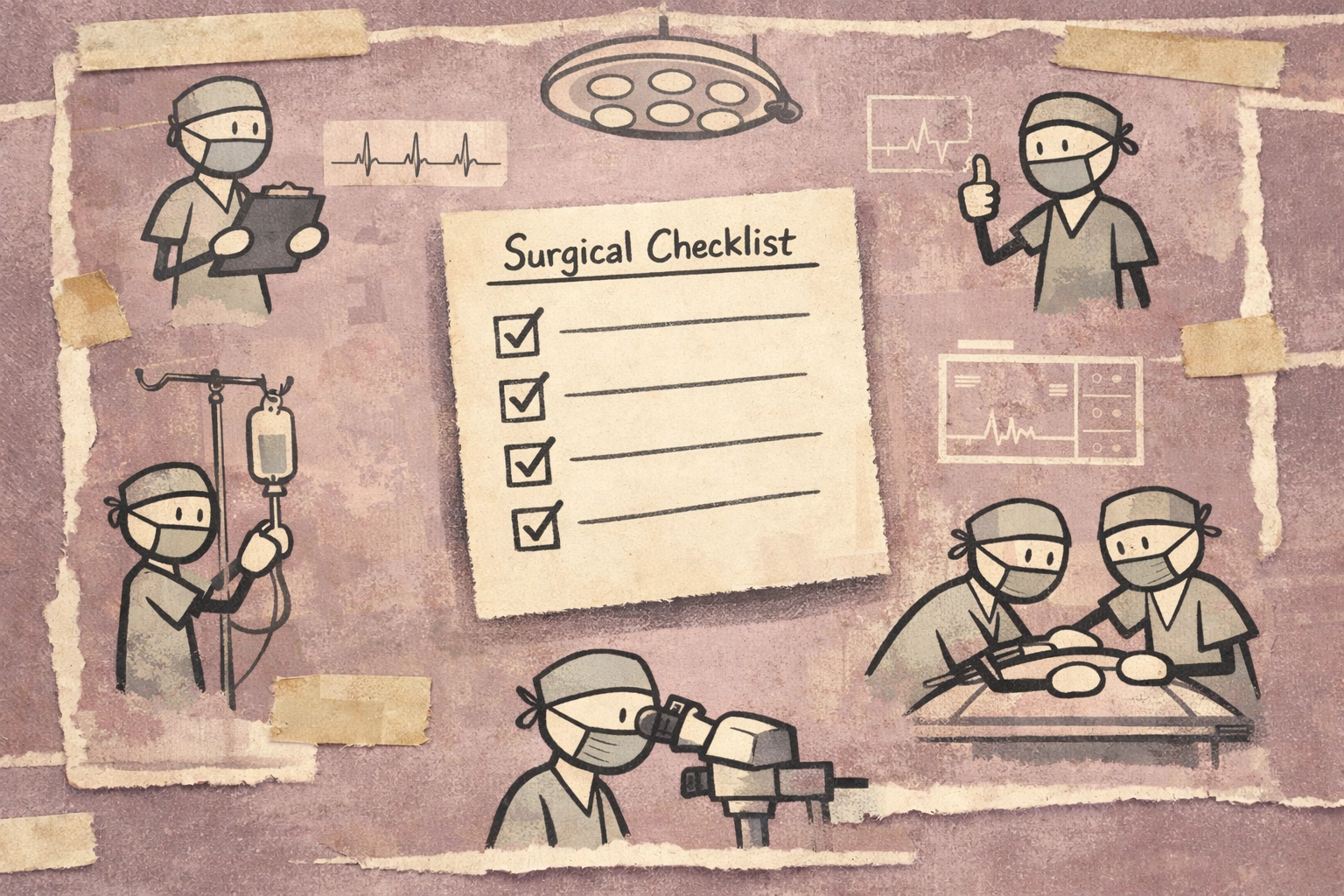
In 2001, Dr. Peter Pronovost introduced a simple five-item checklist in Michigan ICUs to prevent infections during central line insertions.
The result? Infection rates dropped by 66% in three months.
These were world-class surgeons. Highly trained. Brilliant.
And yet, a laminated piece of paper with five bullet points saved more lives than another decade of medical school ever could.
Why?
Because the checklist didn't rely on anyone's willpower, memory, or heroic effort.
It just existed. Constant. Reliable. Boring.
Now ask yourself: How many "infections" are happening in your business because you're relying on your brain instead of a system?
Missed follow-ups. Forgotten client requests. That project you swore you'd finish "next week" three months ago.
Your willpower isn't the problem.
Your reliance on willpower is.
The Ferrari on a Lawnmower Engine Problem
Naval Ravikant talks about leverage constantly.
Code. Media. Capital. People.
But there's a prerequisite nobody mentions: You need the machine underneath to hold it.
You can't scale a Ferrari on a lawnmower engine.
And you can't scale a business on willpower alone.
Here's what that looks like in real life:
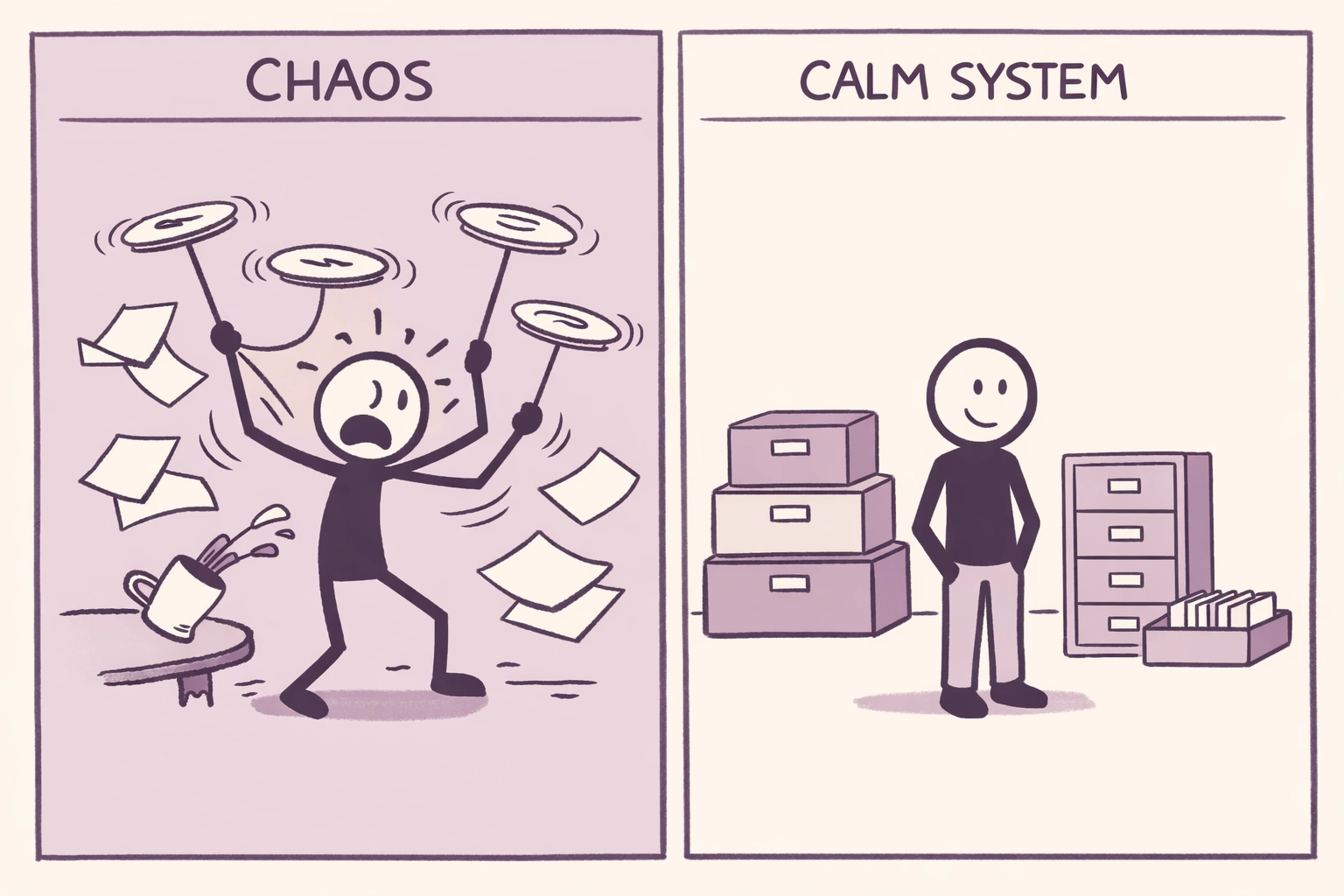
Scenario A (Willpower Model):
- You remember to invoice clients… sometimes.
- You manually track deadlines in your head.
- Every morning starts with "What was I supposed to do today?"
- You work weekends to catch up on admin you forgot during the week.
Scenario B (Systems Model):
- Invoices send automatically.
- Deadlines live in a system that reminds you.
- Every morning starts with "Here are your three priorities."
- Weekends are for living, not cleanup.
Same brain. Different engine.
One costs you nights and weekends. The other costs you an afternoon to set up.
Which one sounds like a better investment?
The Variable vs. The Constant
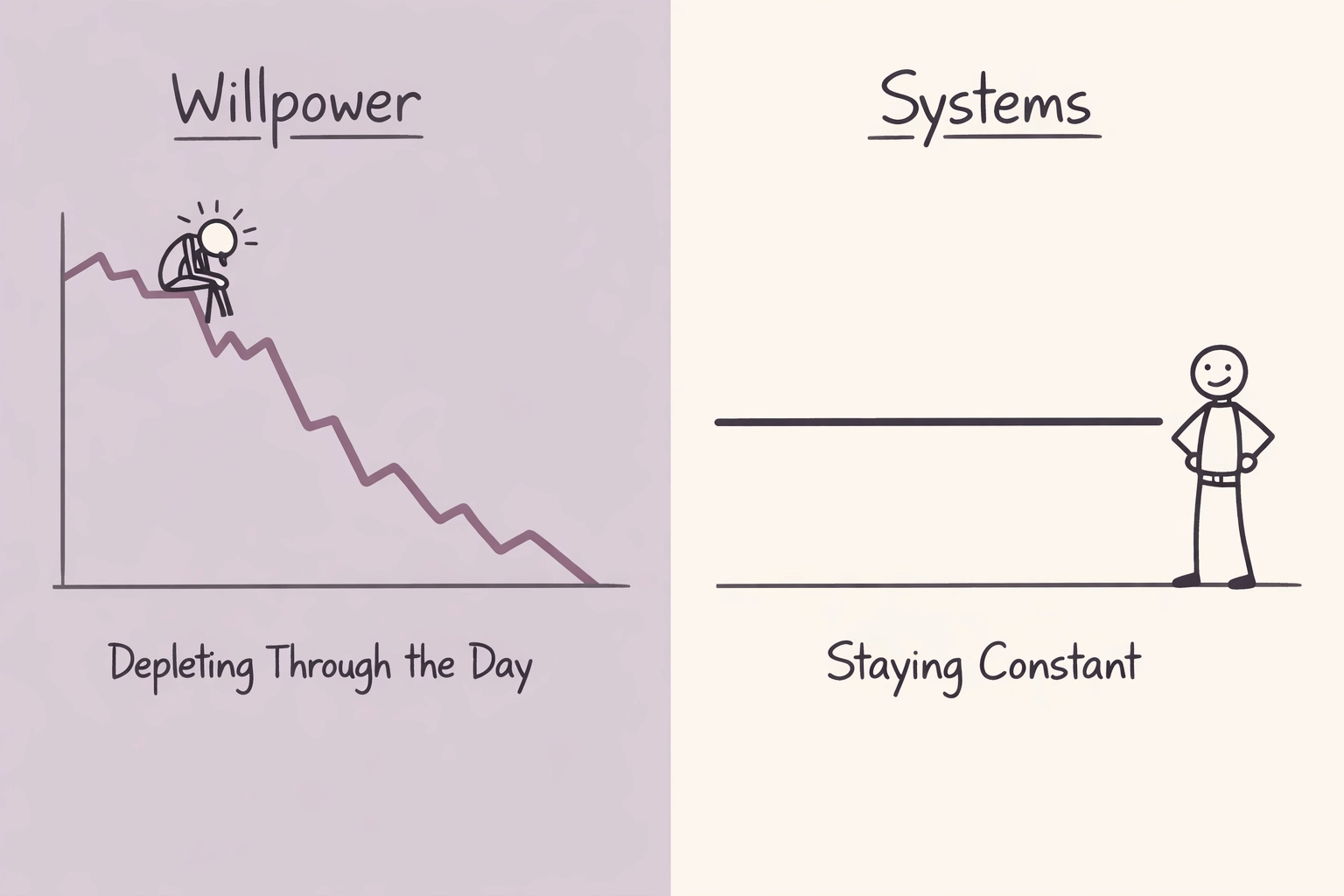
Here's a graph you need burned into your brain:
Willpower over a 16-hour day:
Morning: 100% · Lunch: 73% · 3 PM: 41% · Evening: 19%
Systems over a 16-hour day:
Morning: 100% · Lunch: 100% · 3 PM: 100% · Evening: 100%
You're betting your business on a resource that literally depletes every hour you're awake.
That's not strategy. That's hope.
And hope is not a business model.
The Permission You're Waiting For
I'm going to say the thing you need to hear:
You don't need more discipline. You need better systems.
The reason you keep "failing" at habits isn't because you're weak.
It's because you're trying to bench press a business with your bare hands instead of building the machine that does the lifting.
This is what I call The Discipline Delusion: the belief that real success comes from never slipping, never resting, never automating.
It's a lie sold to you by people who've never built anything at scale.
Research backs this up. Studies show that people who plan "cheat days" stick to diets longer than people who white-knuckle perfection. The ones who allowed slack — room for error, recovery, humanity — were more successful long-term.
Why? Because willpower needs replenishment.
Systems don't.
The Operator vs. Owner Shift
Here's the thing nobody tells you when you start getting good at stuff:
Your competence becomes your cage.
You can write all the content, so you do.
You can handle customer service, so you do.
You can build the decks and run the meetings and manage the finances, so you do.
And suddenly, you're paying yourself $8/hour to do tasks you'd never hire someone else to do.
That's not being a founder. That's being the most expensive employee you'll ever have.
Naval said it best: "You're not going to get rich renting out your time."
But you're also not going to get rich renting out your willpower.
The shift from Operator to Owner isn't about working less.
It's about designing the machine so your brain can do what only it can do.
Strategy. Vision. Relationships.
Not remembering to send invoices.

The Real Cost of "Powering Through"
Let's talk money.
If you make $200K/year, your time is worth roughly $100/hour.
Now count how many hours you spent last week on:
- Searching for that file you know you saved somewhere
- Redoing work because you forgot a step
- Firefighting problems that shouldn't have been problems
- Manually doing something you've done 50 times before
Let's say it's 10 hours. That's $1,000/week. $52,000/year.
You just paid yourself $52K to not have systems.
That's the willpower tax.
And it's compounding.
The Boring Stuff That Actually Works
Here's what I do with my co-building clients:
We skip the motivation. Skip the goals. Skip the "just try harder" pep talk.
We start with the boring stuff.
What decisions are you making over and over? What tasks require your memory but not your genius? What's draining you that could be automated, delegated, or eliminated?
Then we build the boring stuff.
The checklists. The templates. The workflows. The "second brain" that holds the weight so you don't have to.
Because here's the thing about systems: They don't have bad days.
They don't get decision fatigue. They don't forget. They don't need pep talks.
They just work.
While you sleep. While you're on vacation. While you're doing the $1,000/hour work only you can do.
The Only Bet That Scales
So here's my challenge to you:
Stop investing in willpower.
Start investing in systems.
Stop asking "Can I do this?"
Start asking "Should I be doing this?"
Because you're too expensive to be your own assistant.
You're too smart to keep burning your best resource on tasks that don't require it.
And you're too close to building something that actually scales to keep running it on fumes and coffee.
The discipline delusion tells you to try harder. The systems mindset tells you to build better. One of those leaves you exhausted at 9 PM wondering where the day went. The other compounds while you sleep.
Choose accordingly.
References
- Baumeister, R.F., & Tierney, J. (2011). Willpower: Rediscovering the Greatest Human Strength. Research on ego depletion and decision fatigue.
- Clear, James. (2018). Atomic Habits: An Easy & Proven Way to Build Good Habits & Break Bad Ones. Avery.
- Pronovost, P., et al. (2006). "An Intervention to Decrease Catheter-Related Bloodstream Infections in the ICU." New England Journal of Medicine, 355(26), 2725-2732.
- Ravikant, Naval. (2020). The Almanack of Naval Ravikant. Magrathea Publishing. On leverage and wealth creation.